_edited_9.png)
Table of Contents
INTRODUCTION
Selecting a water filter can be challenging, especially since many products make similar claims regarding performance and contaminant removal. One of the easiest ways to identify a reliable product is to look for NSF-certified water filters, tested independently against recognized safety and performance standards.
In this guide, we’ll explain what NSF certification is all about, why it matters, and how valuable it can be for Australian homeowners as they gain more confidence in choosing a filtration system.
What Does NSF Certification Actually Mean?
NSF International provides an independent way to verify that water filter products meet specific performance and safety tests. Certification does not mean just a one-time inspection of the product; it includes laboratory testing, manufacturing evaluations, and continual testing.
Instead of making generalized promises about the products, certified companies must demonstrate the ability of their products to consistently meet established product standards.
What Is NSF?
NSF International was originally founded in 1944 as the National Sanitation Foundation. Today it operates as an independent global organization responsible for developing public health standards and certifying products across food safety, water treatment, and consumer product categories. The NSF is responsible for creating public health standards and testing products that are used in food, medicine, and consumer product applications.
As an independent entity (versus being a manufacturer), the NSF’s certification is highly respected worldwide.
What Is the Process for Certification?
Certification is the process by which a manufacturer submits their products for testing to determine if the product meets the claim the manufacturer makes about contaminant removal.
The manufacturing process will also be reviewed to ensure that the products are manufactured to the same quality standard one time after certification ends, so the company can continue to meet the quality standard.
The production of certified products is periodically audited and evaluated to ensure compliance with the standards, and this is an ongoing process rather than being a one-time event or approval.
Why NSF Certified Water Filters Give Homeowners More Confidence
Choosing a water filter is often about comparing a dozen products that share similar descriptions. Many claim to have removed chlorine, heavy metals, sediment, or some harmful chemicals; however, independent testing is usually rare, so these claims are impossible to verify properly.
Several major benefits are associated with using NSF-certified water filter systems:
- Independent laboratory tests, as opposed to just manufacturer claims.
- Contaminants have reduced exposure based on recognized standards.
- Increased confidence about product quality and consistency.
- Ongoing inspections of manufacturers’ processes.
- A more in-depth understanding of filtration systems’ operational properties.
So, for many homeowners, certifying the filter reduces the uncertainty of which filtration system to use.
Different NSF Standards Every Homeowner Should Know
Not all NSF certifications eliminate the same contaminant. NSF certifications are different because they evaluate various elements of the filtration systems and must be understood correctly so that you know what each certification classifies.
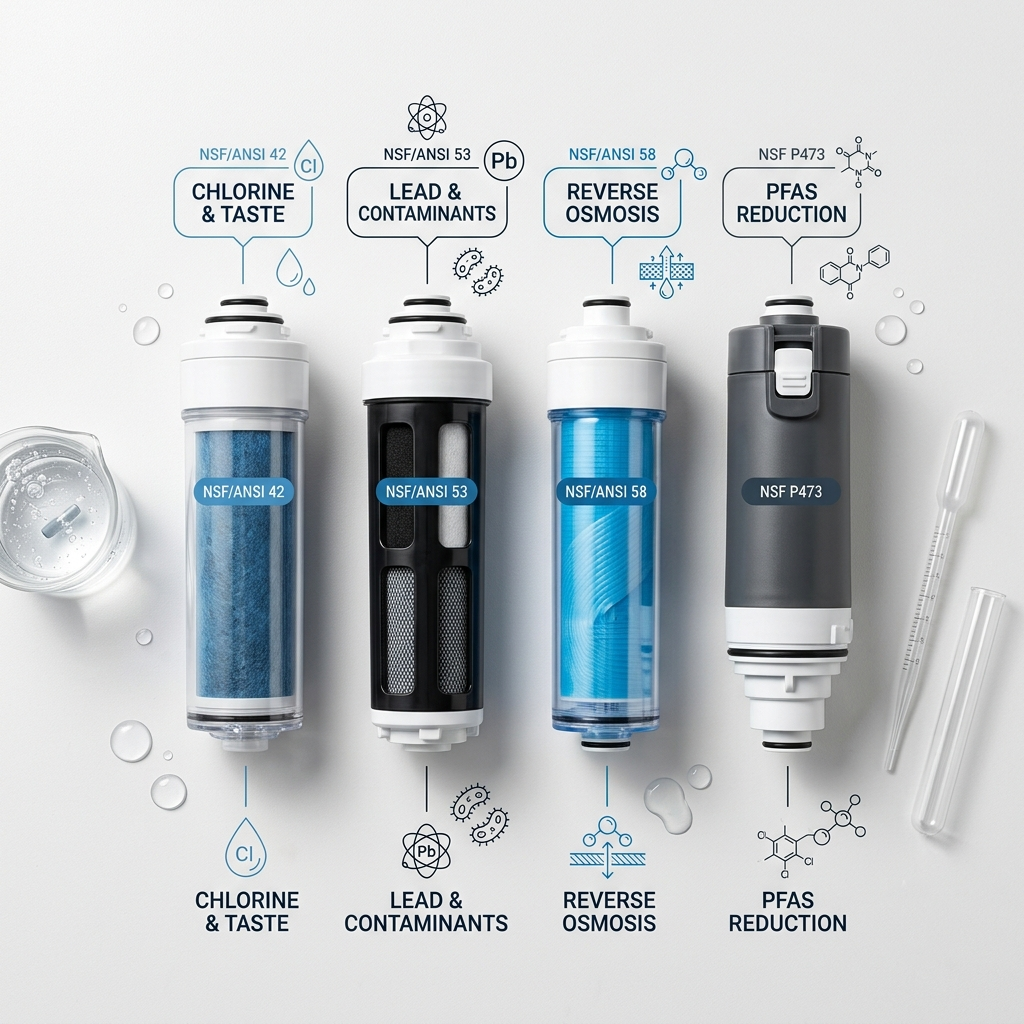
NSF/ANSI 42 – Taste & Appearance
NSF/ANSI 42 addresses aesthetic improvements to water quality, primarily taste and appearance, and does not cover health-related contaminantsTherefore, the NSF/ANSI 42 tests primarily for reduction in chlorine taste, chlorine odor, and other particulates that would reduce the appearance of water.
So, if all you want is to improve your drinking water, you would look to buy an NSF/ANSI 42 filter.
NSF/ANSI 53 Tests for Health-Related Contaminants in Water
Filters, which reduce contaminants that may impact human health, are tested to NSF/ANSI 53 standards. The specific filter will detail its certification for reducing substances such as lead, cysts, volatile organic compounds (VOCs), and other contaminants present in water, which are detrimental to human health.
Many homeowners will regard NSF/ANSI 53 certification as one of the most valuable certifications they will consider when comparing water filter products for their homes.
NSF ANSI 58 Tests for Reverse Osmosis Systems
Reverse osmosis systems operate very differently than traditional carbon filters and require specialized testing to ensure their performance. NSF/ANSI 58 certification evaluates the overall performance of a reverse osmosis unit as well as the membrane effectiveness at removing contaminants.
As reverse osmosis technology is capable of filtering a greater variety of impurities, NSF/ANSI 58 is associated with higher quality drinking water systems.
NSF/ANSI 401: Emerging Contaminants
This standard is established to focus on reducing the levels of all types of emerging contaminants. Some of these include pharmaceuticals, herbicides, pesticides, and industrial chemicals that may occasionally be found in drinking water.
Not every home requires such a high level of filtration, but it provides a reference for consumers looking for filters that can assist in reducing these newer drinking water quality concerns.
NSF P473: PFAS Reduction
Due to the increasing public awareness of PFAS contamination, there has been much interest in this new certification. NSF P473 certifies products used for the reduction of various PFAS types from drinking water.
As PFAS continue to have a global impact on the environment, many households are investigating systems that will help with the reduction of these long-lasting contaminants.
Which NSF Standard Do Australian Households Need Most?
For most Melbourne and Sydney households where chlorine taste is the primary concern, NSF/ANSI 42 certification is sufficient. Households in older inner-city homes with pre-1970 plumbing, particularly in suburbs like Fitzroy, Collingwood, or Newtown, should prioritize NSF/ANSI 53 for lead reduction. Residents near RAAF bases, airports, or industrial sites with known PFAS contamination should look specifically for NSF P473 certification. Perth and Adelaide households dealing with harder water and higher dissolved solids may benefit most from a reverse osmosis system carrying NSF/ANSI 58. For households wanting the broadest possible protection, a multi-stage system carrying NSF/ANSI 53 and NSF/ANSI 58 certifications covers the widest range of health-related contaminants.
Certified vs Non-Certified Water Filters
At first glance, certified and non-certified filters may look nearly the same. Often, their product descriptions, packaging, and prices can be almost indistinguishable from one another, making it difficult to compare them at all.
However, the main difference between the two is that certified filters have been independently verified through structured lab tests to verify that they perform as claimed, while non-certified filters can be based solely on what you find in the manufacturer-supplied documents.
This does not automatically mean that every non-certified filter performs poorly, but certified filters do offer an independently verified level of assurance that non-certified products cannot match Because verification of performance has occurred by an independent third party as opposed to simply relying on faith.
If a homeowner intends to invest in water filtration systems for the long term, this could be a very important consideration when buying.
Common Misconceptions About NSF Certification
A few misconceptions regarding NSF certification are prevalent.
Typically, individuals misunderstand that NSF certification implies that a filter is guaranteed to remove any and every contaminant there may be. In truth, the items that are certified under the appropriate NSF standard only removed those listed under that same NSF standard.
Furthermore, consumers can’t assume that each certified filter works exactly the same because not every filter offers the same certifications relative to the intended function of the filter, so two filters with various certifications may very well have completely different water quality problems.
Finally, because of this misunderstanding, there are people who think that once an item has received a certification, that certification is permanent.
How to Verify Whether a Water Filter Is Truly NSF Certified
There are many different water filter options on the market today. It’s easy to come across statements such as “tested to NSF standards” and “manufactured with NSF-certified materials.”
Although these types of statements may look promising at first glance, they do not necessarily mean that a water filter has complete NSF certification. Therefore, learning how to verify a water filter will assist homeowners in avoiding deceiving marketing tactics when making their purchases.
How to Read an NSF Certificate
When you locate a product in the NSF online database, the certificate will show the specific standard the product is certified to, the exact contaminants it has been tested to reduce, the reduction percentage achieved in testing, and the certification expiry date. Pay close attention to the contaminant list a filter certified to NSF/ANSI 42 will only show chlorine and aesthetic parameters, not lead or PFAS. If the product page claims broad contaminant removal but the NSF certificate only lists one or two parameters, the broader claims are unverified.
Search the official NSF certification database
You’re able to search their official NSF online certification database to see if a product is certified. You can search for products by manufacturer, model number, and the NSF standards that a product has met so that you can confirm the exact tests performed on a water filtration product.
Look Beyond the NSF Logo
Some people believe that the NSF logo on an individual component means that it is part of an entire filtration system. But, in fact, many companies only provide certifications for individual water filtration components. Be sure to check to see if the certification is for the entire filtration system or just for some of its parts.
Take A Look at the Performance Claims
The NSF certification clearly outlines what contaminants the filter has been tested to remove. You should compare the certification with your home’s water quality issues before you buy a filter. Just because a filter has been certified for chlorine reduction does not mean it has also been certified to reduce lead, PFAS, or pharmaceuticals.
Taking a few moments to verify the certification will give you significant confidence in our investment.
Why NSF Certification Matters for Australian Households
Australia has been associated with providing clean drinking water. However, many consumers continue to install water systems inside their homes in order to improve the quality of the water they consume. There are several reasons that result in the increased consumption of residential water filtration systems.
In addition to the municipal water supply, an NSF-certified product provides consumers with an assurance that the product has been tested independently under internationally recognized standards.
The importance of certification can be highlighted in a number of key areas, which include:
- Increased confidence in filtration performance.
- Verification independent of marketing claims.
- Additional transparency for the consumer.
- Improved long-term reliability.
- Facilitated comparison between multiple manufacturer products.
While certification does not replace local water quality guidance, it provides Australian consumers a credible standard to evaluate various types of filtration systems on the market.
In Australia, homeowners should also look for watermark certification when purchasing plumbing products connected to drinking water systems. Watermark confirms that products comply with Australian plumbing regulations and are approved for installation under the Plumbing Code of Australia. While NSF focuses on filtration performance and contaminant reduction, Watermark ensures the product is legally suitable for use within Australian plumbing systems.
How to Choose the Right NSF-Certified Water Filter
When it comes to dealing with filtration systems, simply getting the highest certification is not a determinant. The type of solution best suited would be discreetly gauged according to the water quality of the concerned home, number of household members, budget available, and expected longevity after installation.
Compare and Select the Right Certification for Your Needs:
Many different NSF standards exist to address various water quality concerns. Don’t make the mistake of assuming one certification covers all your needs. Make sure you are comparing your product’s certified contaminant reduction claims with your household’s needs.
Examples of certification types include:
- NSF/ANSI 42 (Chlorine Taste and Odor),
- NSF/ANSI 53 (Multiple Health-Related Contaminants),
- NSF/ANSI 58 (Reverse Osmosis Systems),
- NSF/ANSI 401 (Some Emerging Contaminants),
- NSF P473 (Certain PFAS Compounds).
Finding the proper certification can help you not only achieve better filtration performance but also enjoy longer-term satisfaction with your product.
Evaluate Maintenance Needs
All filtration systems require regular maintenance to continue functioning properly—things like when to replace filters. When to service it and if there are replacement cartridges available to replace those in use should be looked at before a filter purchase. A certified filter that is cared for and maintained usually has a much, much higher level of reliability compared to a premium system that has no maintenance.
Match the Certification to the Contaminants
Australian homeowners may also consider products endorsed by the Water Quality Association of Australia (WQAA). WQAA promotes best practices within the Australian water treatment industry and supports the use of quality filtration products, professional installation, and compliance with recognized industry standards. Choosing products associated with reputable organizations such as NSF, Water Mark, and WQAA can provide additional confidence when comparing water filtration systems.
Common Buying Mistakes When Choosing Water Filters
When purchasing a water purification system without sufficient research, costly errors could occur when making a purchase or a serious disappointment. There are many common errors to watch for while purchasing a water filtration system that can help you make more informed decisions as a homeowner.
Choosing Based Only on Price
A low-cost water filter may appear to be an attractive choice, but typically these lower-cost filters have a shorter filter life. Lower contaminant reduction rates and limited independent test results. So, when considering your options, be sure that you’re looking at more than just your purchase price. You need to look at overall value, certification, maintenance cost, and long-term durability as well.
Assuming Every Certified Filter Does the Same Job
Certification does not guarantee that every filter filters and purifies all of the same contaminants. Filters that have been certified can have very different performance levels depending on which NSF standard they are certified to. Always check the specific certification and contaminant reduction claims for each individual product rather than assuming all certified filters are equivalent.
Ignoring Replacement Costs
The initial purchase price of the system is only one part of the overall cost associated with purchasing and using the system. The cost of replacement cartridges, service requirements, and maintenance will all add to the total cost of ownership over the life of your system.
If you think about future costs prior to making a real purchasing decision, you’ll often get better long-term value with less money expended.
Why Certification Should Be Part of Every Buying Decision
The technology used to filter water continues to progress, and homeowners now have access to more filtration products than ever before. Because there are more products available to potential buyers than ever before, independent certification has become one of the best ways to distinguish reliable, proven products from unproven.
Rather than relying solely on price or manufacturer advertising, consumers can use NSF certification to make informed decisions based on documented test results and widely accepted industry standards.
Doing so lowers uncertainty and allows consumers to invest with more confidence.
When families look to purchase a filter system that they will be using daily for the next many years, the certification should be an equally important factor as the technology used to filter water, how much maintenance will be required, and the overall quality of the product.
Conclusion
NSF certification is one of the most reliable tools available to Australian homeowners when comparing water filtration products. In a market where many products make similar claims about contaminant removal, independent certification provides documented evidence that a system performs as advertised, not just at the time of launch but consistently through ongoing audits and testing.
Understanding the difference between NSF/ANSI 42, 53, 58, 401, and P473 allows you to match the right certification to your household’s specific water quality concerns, rather than relying on generic marketing claims. Combined with WaterMark certification for plumbing compliance and WQAA endorsement for industry best practices, these standards give Australian consumers a comprehensive framework for making confident, well-informed filtration decisions.
Take the time to verify certification claims through the official NSF database, match the certified contaminant reduction list to your actual water quality needs, and factor in long-term maintenance costs alongside the purchase price. A certified, well-maintained filtration system will deliver reliable performance and genuine peace of mind for years to come.