
Table of Contents
Introduction

This guide covers water quality in Melbourne, where the city’s drinking water comes from, how it is treated, what contaminants may be present, and how households can better understand the water they use every day. While Melbourne is well known for carefully managing its drinking water, tap water quality is affected by more than treatment at the source.
The public network supplies tap water that is treated and monitored to meet national standards. Still, water quality can also be influenced by the plumbing, pipes, and water storage systems within a property. Understanding the difference between water quality as it leaves the treatment facility and water quality at the household tap helps residents make informed decisions about testing and filtration.
Where Does Melbourne’s Drinking Water Come From?
Protected Water Catchments in Victoria
Melbourne’s drinking water is sourced from protected catchments in the Central Highlands and surrounding regions of Victoria. These catchments collect rainfall and direct it to reservoirs that form the core of the city’s water supply network.
The protected catchment model minimizes contamination risk by restricting human activity within the catchment areas, reducing exposure to pollutants from agriculture, industry, and urban runoff. This is one reason Melbourne’s source water is considered among Australia’s cleanest.
However, even protected catchments cannot eliminate all naturally occurring organic matter, minerals, and microorganisms from the water. Source protection alone is therefore always combined with water treatment and ongoing quality monitoring.
Rainfall and Seasonal Conditions Affect Water Sources
Rainfall patterns significantly influence Melbourne’s water supply. Heavy rainfall events can produce runoff that carries soil, organic materials, and other substances into reservoirs and waterways. During droughts, lower water volumes can increase concentrations of naturally occurring materials.
These seasonal variations do not mean the water is unsafe to drink. Water treatment is designed to manage fluctuations in raw water quality and maintain consistent safety at the point of supply. Understanding these natural factors provides useful context for how Melbourne’s water quality is managed over time.
How Is Melbourne’s Drinking Water Treated?
Filtration and the Removal of Particles
Water treatment typically includes filtration stages designed to remove suspended materials and particles, including sediment and natural organic matter. The specific filtration approach depends on the source water characteristics and treatment facility design.
Conventional filtration removes suspended particles but does not eliminate all dissolved substances. For this reason, water treatment is a multi-stage process, and different treatment plants may use different approaches.
Disinfection and Microbial Safety
Disinfection is a critical stage in water treatment, reducing pathogens that could otherwise enter the supply. Depending on the water source and treatment requirements, this may involve chlorine, UV disinfection, or a combination of both.
Chlorine also provides ongoing protection as treated water travels through the distribution network, an important consideration given the distance water must travel through pipes and infrastructure before reaching households. Some water utilities use chloramine as a secondary disinfectant, in place of or alongside free chlorine, because it remains more stable over longer distribution distances.
The specific treatment method used varies between treatment facilities. Residents should check their water supplier’s published information for details specific to their supply zone rather than assuming all treatment plants use identical processes.
Monitoring Water Quality Against Australian Guidelines
Water suppliers monitor drinking water quality to ensure compliance with the Australian Drinking Water Guidelines (ADWG), which provide a national framework for assessing microbiological, chemical, and physical water quality. Monitoring programs typically test multiple points throughout the treatment and distribution system to detect changes, assess treatment performance, and respond when investigation is required.
This monitoring applies to the public mains supply. Private water sources, including untreated bore water or rainwater tanks, have different requirements and responsibilities, and household testing decisions will differ accordingly.
What Substances May Be Present in Melbourne Tap Water?
Chlorine and Disinfection By-Products
Chlorine is used throughout Australian drinking water systems as a primary disinfectant. Some people notice a mild chlorine taste or smell in their tap water, even when the supply fully meets regulatory standards.
When chlorine reacts with naturally occurring organic matter in the water, it can form disinfection by-products (DBPs), including trihalomethanes (THMs) and haloacetic acids (HAAs). Water authorities monitor these by-products against the ADWG limits. Routine monitoring confirms that Melbourne’s water consistently meets these standards. Still, households concerned about disinfection by-products may find that a quality activated carbon filter significantly reduces their presence at the tap.
An unusual or unexpected taste or smell does not automatically indicate a water quality problem. However, persistent changes occurring across multiple taps in a property are worth investigating further.
Naturally Occurring Minerals and Dissolved Substances
Water naturally picks up minerals, including calcium and magnesium, as it moves through soil and rock. These minerals contribute to water hardness, can affect taste, and can cause scale buildup on appliances and fixtures.
The presence of minerals does not indicate contamination. However, the type and concentration of minerals can matter when choosing a filtration system, especially for households dealing with hard water or scale-related appliance issues. Standard carbon filters designed to improve taste typically do not reduce hardness or dissolved mineral content. A water softener or reverse osmosis system is better suited to those concerns.
Metals That May Enter Water Through Household Plumbing
Plumbing materials within the property can affect water quality at the tap. Depending on the building’s age, the materials used in pipes and fittings, and the plumbing’s maintenance history, metals such as lead and copper can enter the property’s water supply.
This differs from treatment plant contamination, where water leaving the municipal supply can fully comply with all guidelines. At the same time, plumbing within an individual property introduces metals at the point of consumption. Properties built before 1970, particularly in older Melbourne suburbs, are more likely to contain lead solder joints or copper fittings that may affect water quality.
If plumbing-related contamination is suspected, arrange specific water testing and, if necessary, consult a licensed plumber rather than choosing a filter without first identifying the cause.
PFAS and Other Emerging Contaminants
PFAS (per- and polyfluoroalkyl substances) are a group of persistent synthetic chemicals used in various industrial and consumer applications, including firefighting foam, non-stick cookware, and water-resistant materials. Their environmental persistence has led to increased monitoring and regulation.
The presence of PFAS as a broader environmental concern does not automatically mean that Melbourne’s mains supply is affected. Whether PFAS is present in a specific water supply depends on local catchment conditions and proximity to known contamination sources. Specific monitoring results and official water quality data for the relevant supply zone are the appropriate basis for assessing this risk. The ADWG includes health-based guidance values for PFAS, and these are updated as scientific evidence develops. Residents with specific concerns should consult their water supplier and the current ADWG.
Does Good-Tasting Water Always Mean It Is Safe?
Why Taste, Color, and Smell Are Not Enough
Taste, color, and smell can indicate water quality but cannot be relied on to identify every water quality issue. Some contaminants can be present at concerning concentrations without noticeably changing the water’s appearance, taste, or odor.
Similarly, a mild chlorine taste does not indicate a health risk; it is a normal characteristic of disinfected water. Taste is influenced by disinfection chemistry, mineral content, and individual sensitivity to particular compounds.
Personal sensory observations should not replace official water quality reports or appropriate testing when genuine concerns exist.
When Should Melbourne Residents Investigate a Change in Water Quality?
Sudden or unexplained changes in water color, clarity, odor, or taste, especially when they occur across multiple taps in a property, are worth investigating. These changes may warrant testing but do not, by themselves, confirm a harmful contaminant.
The recommended first step is to contact the water supplier to check whether a known event or maintenance activity in the distribution network may explain the change. If the issue is confined to a single tap or outlet, the property’s internal plumbing is the more likely source and should be inspected by a licensed plumber.
Always follow guidance from the water supplier if you have any doubt about the safety of the mains supply.
How Does Household Plumbing Affect Water Quality?
Water quality depends not only on treatment and source conditions but also on the plumbing system that delivers water to individual outlets within a property.
Older Properties and Plumbing Systems
Older properties may have plumbing components that are no longer in optimal condition. Aging pipes, particularly those made from materials such as lead or galvanized steel, can affect water quality at specific outlets within the property. A property’s age alone does not confirm a water quality problem, but it is a reasonable basis for targeted testing, particularly for lead in pre-1970 homes.
Stagnant water
Water sitting in pipes for extended periods, particularly overnight or when the property is unoccupied, can accumulate trace metals from contact with plumbing materials. This is most relevant in properties with older plumbing. Running the cold tap for a short period before using the water for drinking or cooking is a simple precaution in these situations.
Importance of Regular Care for Internal Plumbing
Leaks, corrosion, and deteriorating fixtures can introduce water quality issues that originate within the property rather than the supply network. Regular plumbing maintenance helps identify these problems before they escalate. When a water quality change appears to be confined to one outlet, the internal plumbing is the most appropriate starting point for investigation.
How Can Residents Understand Water Quality Information?
Identify Your Water Supply Type
First, determine whether the property receives treated mains water or relies on a private source, such as a rainwater tank or bore water. These sources carry different risks and require different testing and treatment approaches.
Residents on the mains supply should refer to their water supplier’s annual water quality report. Those with private supplies may need more detailed advice specific to their source and storage arrangements.
Learn About Contaminant Concentration Levels
Water testing results show the concentrations of various substances. The presence of a substance in water does not automatically indicate a risk; the concentration matters, and the relevant ADWG guideline value provides the appropriate reference for interpreting results.
Residents should not interpret water quality data without understanding the units of measurement, the testing conditions, and the relevant guideline values. Suppliers publish water quality reports to be publicly accessible and include context for interpreting results.
Understand What the Report Is Designed For
Some water quality reports cover the supply network as a whole, while others focus on specific locations or respond to particular incidents. A general supply-level report may not reflect the water quality at a specific tap within an individual property. Separate household testing or plumbing investigation may be required where property-specific concerns exist.
When Should You Consider Household Water Testing?
Private Water Sources
Private water sources, including rainwater tanks and bore water, are not subject to the same treatment and monitoring requirements as the mains supply. Rainwater tanks can become contaminated with sediment, leaves, animal waste, and microorganisms. Bore water may contain naturally occurring dissolved minerals, salts, or chemicals depending on local geology. Regularly testing private water sources is a practical step for households that rely on them.
Investigating Changes in Colour, Taste, or Smell
A sudden or persistent change in water appearance, taste, or smell can indicate a change in the supply, plumbing, or fixtures. These changes don’t confirm contamination but warrant attention if they persist or occur across multiple outlets.
Check whether the issue affects one tap or several, and whether others in the property are experiencing the same concern. This helps narrow down whether the cause is likely the supply network, the internal plumbing, or a specific fixture.
Can Filtration Help Improve Water Quality in Melbourne Homes?
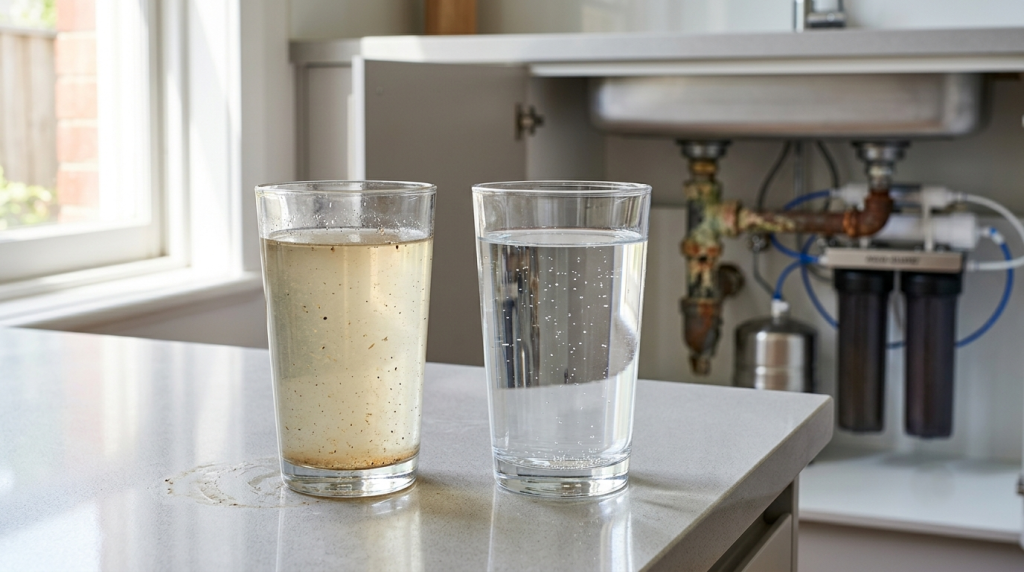
Filtration can address a range of water quality concerns, but the right system depends on the specific issue. Installing a filter without first identifying the problem may result in a system that does not address the actual concern.
Carbon Filters for Taste and Odour
Activated carbon filters are commonly used to reduce chlorine taste and odour and to address some volatile organic compounds. They are a practical and cost-effective option for households that want to improve the taste and smell of their drinking water.
Not all carbon filters perform equally. Effectiveness depends on the filter media type, the specific contaminant being targeted, and whether the system is installed and maintained correctly. For chloramine reduction specifically, catalytic carbon is required; standard carbon filters may perform worse against chloramine than against free chlorine.
Reverse Osmosis
Reverse osmosis systems use a semi-permeable membrane to remove dissolved substances from drinking water, including certain heavy metals, PFAS, fluoride, and dissolved solids contaminants standard carbon filtration does not address. RO systems require more installation space, plumbing, and maintenance. Performance should be verified against the manufacturer’s independently tested specifications for the specific contaminants of concern.
Whole-House Filtration
A whole-house filtration system treats water at the property entry point, providing filtered water at every tap, shower, and appliance throughout the home. This approach is most appropriate when water quality concerns affect the whole property, such as sediment, chlorine odour throughout the house, or hard-water scale affecting multiple appliances.
Whole-house filtration is not necessary for every Melbourne property. The decision should be based on the specific water quality issue identified, the household’s needs, and the practical requirements of installation.
Verify Filter Performance Before Purchasing
Before purchasing any filter, confirm what specific contaminants the model has been independently tested and certified to reduce. General descriptions of filtration capability aren’t enough; check for relevant NSF/ANSI certification and confirm the certified claims match the contaminants you want to address.
Conclusion
Water quality in Melbourne is determined by the source and treatment of the supply, the condition of the distribution network, and the plumbing within each property. Residents who understand these factors and use accurate, source-specific information are better placed to decide whether household water testing or filtration is appropriate for their situation and which approach will actually address their concern.