
Table of Contents
Introduction
This guide explains what TDS in water means, what acceptable levels look like for Australian drinking water, how TDS affects taste and home water quality, and how to measure it with a home testing device. Total Dissolved Solids (TDS) is a measure of the concentration of dissolved substances present in water.
Australian homeowners can use TDS levels as one reference point when comparing tap water, rainwater, bore water, and filtered water. However, TDS is not a direct indicator of water safety, and understanding what a TDS reading actually represents is more useful than simply trying to achieve the lowest number possible.
What Does TDS in Water Actually Mean?
TDS stands for Total Dissolved Solids, a measure of the total concentration of dissolved substances in water. These can include a wide range of minerals and salts such as calcium, magnesium, sodium, potassium, chloride, sulfate, and bicarbonate, among others.
TDS is measured in milligrams per liter (mg/L). A reading of 300 mg/L, for example, means that approximately 300 milligrams of dissolved substances are present in each liter of water.
An important limitation to understand is that TDS is a cumulative measurement, not a test for any specific contaminant. A TDS meter cannot identify what dissolved substances are present, only that a certain total amount exists. Two water samples can have identical TDS readings while containing very different dissolved substances. This is why TDS data should be interpreted carefully and in context, rather than treated as a standalone indicator of water quality.
What Is an Ideal TDS Level for Drinking Water?
No single TDS value is universally ideal for all households. The Australian Drinking Water Guidelines (ADWG) do not include a health-based guideline value for TDS because TDS does not correlate with specific health effects.
The ADWG references 600 mg/L as an aesthetic guideline for palatability; water above this level may develop a noticeably stronger mineral taste that some people find less pleasant. A commonly referenced palatability guide for Australian water is:
TDS Level General Palatability
- 0–600 mg/L is good
- 600–900 mg/L is fair
- 900–1,200 mg/L is poor
- Above 1,200 mg/L is generally unacceptable
These categories reflect taste and preference, not safety. A tap water reading of 700 mg/L does not mean the water is hazardous; it simply indicates a more pronounced mineral taste that some people may find less enjoyable.
TDS Levels in Australian Drinking Water
TDS levels vary considerably across Australia due to differences in water sources and local geology. Based on the Australian Drinking Water Guidelines, TDS concentrations in urban supplies typically range from under 100 mg/L to over 750 mg/L. Regional supplies can reach 1,000 mg/L or higher, and some rural and remote locations with high-mineral groundwater can record significantly elevated readings.
This means TDS levels vary across the country, and what is typical in one area may not apply to another. Urban tap water, borewater, and rainwater can all have different dissolved solids profiles depending on the source and local conditions. Consider TDS alongside the water source, seasonal factors, and any available water quality testing results, rather than in isolation.
What Causes TDS in Water to Increase?
Dissolved solids can enter water from a wide range of natural and environmental sources.
- Natural minerals: Calcium, magnesium, sodium, and other minerals dissolve from rocks and soils as water moves through them, which is why groundwater often has higher TDS than surface water
- Groundwater conditions: Bore water can carry significantly higher mineral content depending on the local geology
- Salinity: In certain regions, dissolved salts contribute substantially to TDS readings
- Water Treatment Processes: Some treatment methods can alter the concentration of certain dissolved ions in the supply
- Plumbing and local infrastructure: Aging pipes and local environmental conditions can also influence the dissolved solid composition of water at the tap
Can High TDS in Water Affect Your Health?
TDS as a measurement does not indicate a direct health risk. The Australian Drinking Water Guidelines confirm that elevated TDS levels are not associated with adverse health effects on their own. From a health perspective, what matters is the nature of the specific substances contributing to the TDS reading, not the total figure.
Calcium and magnesium, for example, are naturally occurring minerals that are harmless at typical drinking water concentrations. Other dissolved substances such as lead, nitrates, or PFAS can raise health concerns if present above safe levels, but a TDS meter cannot identify or quantify them. They require separate, specific testing.
Very high TDS can contribute to aesthetic issues such as strong mineral taste and increased scaling in pipes and appliances. In some circumstances, very low TDS can contribute to corrosive water conditions. However, neither high nor low TDS is inherently dangerous based on the TDS reading alone.
Why a Low TDS Reading Does Not Always Mean Better Water
Many people assume lower TDS automatically means safer or better-quality water. This is not accurate.
- TDS measures the total quantity of dissolved substances but says nothing about whether the water is free from specific contaminants
- Water with a very low TDS reading can still contain harmful microorganisms, certain chemicals, or other substances that require separate testing to detect
- A reading of 50 mg/L does not confirm that the water is safe to drink; it only confirms that very little is dissolved in it.
The more useful approach is not to pursue the lowest possible TDS reading but to understand what is actually present in the water and select treatment accordingly based on identified water quality issues.
How Can You Test TDS in Water at Home?
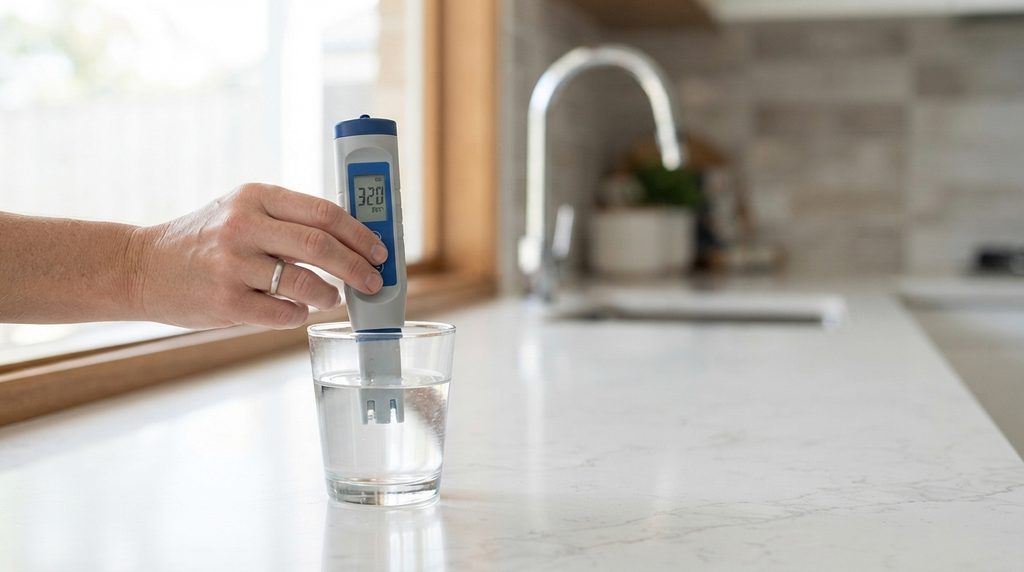
Home TDS testing is straightforward and affordable. Portable TDS meters are widely available and measure water’s electrical conductivity, converting that result into an estimated TDS value.
For a representative home test, follow these steps:
- Use a clean container or glass
- Collect water from the cold drinking water tap
- Avoid touching the sensor with fingers
- Rinse the probe with clean water before testing
- Insert the probe into the water sample according to the manufacturer’s instructions
- Wait for the reading to stabilize
- Record the result, date, and water source
Testing the same tap at different times helps you monitor whether readings stay consistent and compare readings before and after installing a filtration system.
How Does a TDS Meter Work?
Consumer-grade TDS meters do not identify individual dissolved substances. They measure the electrical conductivity of the water, the ability of dissolved ions to carry an electrical current, and convert that conductivity reading into an estimated TDS figure.
Water with more dissolved ions conducts electricity more effectively, producing a higher conductivity reading and therefore a higher estimated TDS value.
The conversion from electrical conductivity (measured in µS/cm) to TDS (measured in mg/L) uses a conversion factor. In Australia, this factor typically ranges from approximately 0.5 to 0.64, depending on water temperature and chemistry. For example, an EC reading of 500 µS/cm multiplied by 0.64 gives an estimated TDS of about 320 mg/L. This is an approximation, not a precise chemical measurement.
Minor differences between readings from two meters are normal and result from variations in calibration, temperature, and meter quality. Household TDS meters work best as monitoring tools rather than substitutes for laboratory-grade water quality analysis.
TDS in Water: Understanding EC and TDS
Electrical conductivity (EC) and total dissolved solids (TDS) are closely related but are not the same measurement.
EC refers to how well water conducts electricity, a property that increases with dissolved-ion concentration. TDS estimates the dissolved material present, derived from the conductivity reading using a conversion factor.
The simplified relationship is:
TDS ≈ EC × conversion factor
For example: 500 µS/cm × 0.64 = approximately 320 mg/L TDS.
The Australian Drinking Water Guidelines note that this relationship depends on the water’s specific chemical composition and temperature so that the conversion factor can vary. This is why TDS readings from home meters should be treated as indicative estimates rather than precise measurements equivalent to laboratory analysis.
Laboratory Testing vs Home TDS Testing
A home TDS meter is a useful tool for quick monitoring and for tracking changes after a filtration system has been installed. However, laboratory testing provides a significantly more detailed and accurate picture of water quality.
A NATA-accredited laboratory can test for specific substances, including:
- Heavy metals such as lead, arsenic, and mercury
- Nitrates and nitrites
- Fluoride
- Biological contaminants
- PFAS compounds
- Individual minerals and salts
- Other parameters specific to the water source type
The Australian Drinking Water Guidelines note that the most accurate way to measure total dissolved solids is through comprehensive analysis of the relevant cations and anions present in the water. For homeowners concerned about the safety of their drinking water, particularly those on bore water, rainwater tanks, or older plumbing, laboratory testing provides far more actionable information than a home TDS meter alone.
What Can a TDS Meter Not Detect?
The most important limitation of a TDS meter is that it cannot identify what is dissolved in the water, only that a certain total amount is present. A TDS reading provides no information about whether the dissolved solids are harmless minerals like calcium or potentially harmful substances like lead or nitrates.
TDS meters also cannot detect microorganisms, bacteria, viruses, or other biological contaminants.
This means a TDS reading cannot confirm that water is safe to drink. For households relying on bore water, rainwater tanks, private water supplies, or properties with ageing plumbing, comprehensive water quality testing is far more informative than TDS measurement alone.
How Water Filtration Can Change TDS
Different filtration technologies affect dissolved solids in different ways, and understanding these differences helps in selecting the right system for your water quality concern.
Reverse Osmosis
Reverse osmosis is one of the most effective household methods for reducing dissolved solids. The semi-permeable membrane blocks most dissolved salts and other substances, which is why filtered water from an RO system typically shows a significantly lower TDS reading than the incoming tap water. RO systems require regular maintenance and produce wastewater during operation; recovery efficiency varies by model, so compare it before purchasing.
Activated Carbon Filtration
Activated carbon filtration is widely used to improve taste and odour, and to reduce chlorine and some organic compounds. Standard activated carbon filtration does not primarily target mineral salts, so you should not expect a significant reduction in TDS readings from a carbon filter alone. This distinction matters when comparing filtration technologies.
Water Softeners
Water softeners address calcium and magnesium hardness through ion exchange, replacing hardness minerals with sodium ions. This can influence TDS readings, but a water softener is not equivalent to an RO system for overall dissolved solids reduction. The right choice depends on whether the primary concern is water hardness, scaling, taste, or a specific identified contaminant.
Distillation
Distillation involves boiling water and collecting the condensed steam, leaving most dissolved solids behind. It effectively reduces TDS but is energy-intensive and not always practical for high daily water volumes. The Australian Drinking Water Guidelines note that reverse osmosis, ion exchange, and distillation are all viable methods for reducing dissolved solids, but each requires energy and ongoing operating costs.
When Should Australian Homeowners Consider Water Filtration?
The decision to install a water filtration system should be based on the specific water quality issue, not a desire to reduce TDS for its own sake.
One household may be dealing with chlorine odour and taste. Another may have hard water causing scale on appliances and fixtures. A third may have a specific contaminant identified through laboratory testing that requires targeted treatment. Each situation calls for a different filtration approach.
Key factors for Australian homeowners to consider before selecting a filtration system:
- Water source: Whether the supply comes from mains, bore water, rainwater, or a private source
- Water quality: What the TDS reading indicates in context, and what specific contaminants have been identified through testing
- Household needs: Whether drinking water treatment or whole-house filtration is the priority
- Maintenance: What ongoing filter replacement and servicing the system requires
- Installation requirements: Available space, plumbing configuration, and water pressure
- Operating costs: Replacement filter costs, energy consumption, and wastewater production for systems that generate it
Water filtration specialists can help interpret water test results and select a system matched to the identified water quality concern, not just a TDS target.
Does TDS Matter for Whole-House Water Filtration?
TDS is one useful metric when evaluating a whole-house filtration system, but it should not be the only consideration. A whole-house system may be designed to address sediment removal, chlorine reduction, taste improvement, or hardness, and the selected technology should match the specific issue, not simply aim for the lowest TDS output.
High TDS can indicate a higher likelihood of scale formation in hot water systems, taps, showerheads, and appliances where minerals tend to accumulate. This is a practical consideration when selecting treatment technology for a property with elevated dissolved mineral content. However, the full water quality picture, including what specific substances are present, should inform the system choice rather than TDS alone.
Final Thoughts
TDS levels provide useful information about the total concentration of dissolved substances in water and can indicate likely taste and palatability. They are a practical monitoring tool, particularly for tracking changes before and after filtration. However, TDS cannot indicate whether water is safe to drink, identify specific contaminants, or replace comprehensive laboratory water quality testing.
For Australian homeowners, the most effective approach is to use TDS readings as an initial monitoring tool, follow up with appropriate water testing where specific concerns exist, and select filtration technology based on the actual water quality issues identified, not on achieving a particular TDS number.