_edited_9.png)
Table of Contents
INTRODUCTION
Activated carbon filters are one of the most widely used water filtration technologies in Australian homes. They appear in whole-house systems, under-sink units, benchtop filters, and refrigerator filters, making them one of the most versatile and accessible filtration options available. Most homeowners are aware that carbon filters improve the smell and taste of water but do not know how they work. Hence, knowing how activated carbon filters are structured and how long they last will enable them to choose wisely.
This guide takes a detailed look at the design, functionality, lifespan, and long-term value of an activated carbon filter, helping Australian homeowners better understand one of the most important technologies used in modern water filtration.
What Is an Activated Carbon Filter?
An activated carbon filter uses specially treated carbon material to remove impurities from water. The activation process creates an enormous internal surface area. A single gram of activated carbon can have a surface area exceeding 1,000 square metres, allowing it to capture and hold a wide range of contaminants through adsorption.
When water passes through the filter, impurities stick to the carbon surface via adsorption, which helps the filter remove unwanted materials from the water.
How It Differs from Ordinary Carbon
Although the regular and activated phases of carbon may seem similar, there is a significant difference in their functionality.
Activated carbon goes through the process of activation to create tiny holes in its structure. Thanks to these pores, activated carbon can have a much larger surface area than ordinary carbon.
Why Activated Carbon Filters Are So Popular
For many years, the activated carbon filter has been considered one of the most reliable filtration options on the market. One of the reasons this technology has managed to gain popularity is because it makes it possible to enhance the quality of water without complicated technology or expensive operation costs.
In the Australian context, activated carbon filtration is particularly effective because the primary water quality concern for most metropolitan households is chlorine taste and odour from municipal disinfection, precisely what activated carbon addresses most effectively. Melbourne’s soft catchment water and Sydney’s similarly protected supply both respond well to standard carbon filtration. Adelaide households, who frequently report stronger chlorine taste due to Murray River sourcing, see among the most noticeable improvements after installing a carbon filter. Perth residents dealing with harder water may benefit from carbon filtration combined with a softening stage for optimal results.
Many homeowners in Australia have chosen to have an activated carbon filter installed in their household because it can remove the smell, unpleasant tastes and some chemical impurities from the water. It is also compatible with many other systems, making it a suitable option for a range of applications.
Key reasons for their popularity:
- Ensures better taste and smell of the water.
- Doesn’t require electricity.
- Can be used with several filter types.
- Cost-effective in terms of maintenance.
- Easily available throughout Australia.
These advantages make the activated carbon filtration system popular among residential as well as commercial users.
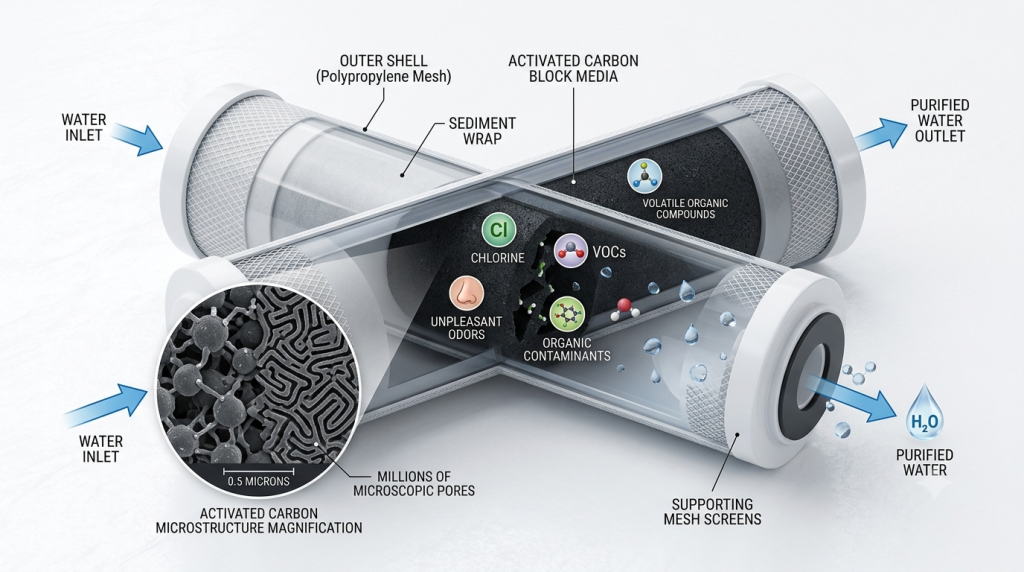
Understanding the Internal Structure of an Activated Carbon Filter
Even if an activated carbon filter looks simple on the outside, like any other filter, it has a sophisticated internal design that improves filtration efficiency.
Different parts of an activated carbon filter work together to ensure successful filtration while water flows freely.
Outer Shell
The shell houses the internal filtration media and directs the water through the proper channel. Most new systems are constructed from strong, food-grade materials designed to last.
Activated Carbon Media
The carbon media is the core of the filter. This activated carbon media has millions of tiny pores that trap impurities and improve water quality.
The efficiency of the carbon media will also determine the effectiveness and longevity of the filter.
Supporting Screens and Layers
The supporting screens help distribute water evenly in the filter. This ensures proper contact between the water and the carbon media, resulting in improved filtration.
Different Types of Activated Carbon Used in Water Filtration
Various types of carbon are used in different kinds of activated carbon filters. Different types are created for different filtration needs.
Granular Activated Carbon (GAC)
Granular activated carbon is made up of carbon particles arranged loosely in a filter cartridge. It is generally utilized to improve the taste of water, reduce chlorine levels, and manage smells. It is commonly used in home filtration systems because it provides effective filtration and reliable flow.
Carbon Block Filters
Carbon block filters compress activated carbon into a dense solid block, increasing the contact time between water and the filter media and improving contaminant removal compared to loose granular carbon.
Due to the high density of the filtration medium, carbon block filters offer higher contaminant removal than conventional granular carbon systems.
Carbon block technology is used in many top water filtration systems to achieve superior filtration effectiveness.
Catalytic Activated Carbon
Catalytic carbon is an advanced carbon technology that aims to improve the filtration of certain contaminants.
It serves well in certain advanced water treatment technologies that require higher chemical filter efficiency.
How Activated Carbon Filters Remove Contaminants
An activated carbon filter works in a more sophisticated way than people think. Different processes interact together and improve the quality of water.
Adsorption
Adsorption is the principal process used in filtration.
Water running through the carbon medium has pollutants stick to the carbon surface, and these pollutants accumulate in the filter.
Physical Filtration
An activated carbon filter can help remove some solid particles or sediment from the water passing through it.
Although the filters were not intended for sediment filtration, they still help with making water appear cleaner.
Chemical Reduction
During filtration, some chemical compounds interact with the carbon surface, reducing substances that cause bad taste and odor in water.
It is the interaction of those three processes that makes the filtration process highly efficient.
What Can an Activated Carbon Filter Remove?
The primary reason homeowners opt for an activated carbon filter is its ability to enhance water quality. Even though an activated carbon filter isn’t meant to remove all impurities, it still does a good job of eliminating those that affect the taste, smell, and appearance of water.
Some of the contaminants that can be treated through activated carbon systems are discussed here in detail:
Chlorine and chloramine: Chlorine is routinely added to municipal water supplies as a disinfectant. While safe at regulated levels, it produces an unpleasant taste and odor that most people notice immediately. Some Australian water authorities also use chloramine as a secondary disinfectant; activated carbon filters, particularly catalytic carbon variants, are effective at reducing both.
Volatile Organic Compounds (VOCs): Various VOCs may be removed by carbon-based systems depending on their source, whether industrial, fuel, or household.
Some herbicides and pesticides: Certain pesticides/herbicides used in farming can be filtered through the use of activated carbon as well.
Industrial chemicals: Depending on concentration and kind of industrial chemicals, activated carbon can be used to remove undesirable contaminants from drinking water.
Unpleasant tastes and smells: This technology may also be used to treat water that tastes stale or has a distinct smell.
For many Australian homes, these benefits equate to better drinking water for cooking and other household purposes. For this reason, activated charcoal remains one of the most popular filtration technologies for home water treatment systems.
What Activated Carbon Filters Cannot Remove Effectively
Although activated carbon filtration provides high efficiency, it does not guarantee complete removal of all contaminations. There are cases when improving water quality requires additional treatments.
Some examples are:
- Dissolved salts
- High levels of minerals
- Certain heavy metals
- Some bacteria and viruses
- High total dissolved solids (TDS)
In the mentioned cases, activated carbon filtration can be used together with reverse osmosis, ultraviolet purification, or some specific filtration medium.
When to Consider Upgrading Beyond Activated Carbon
For many Australian households, a quality activated carbon filter is sufficient for everyday water quality improvement. However, certain situations call for more advanced filtration technology:
- Older homes with pre-1970 plumbing: Lead contamination requires a filter certified to NSF/ANSI 53, which covers health-related contaminants that standard carbon filtration alone does not address
- PFAS contamination concerns: Households near military bases, airports, or industrial sites should consider a reverse osmosis system certified to NSF P473 for PFAS reduction
- Very hard water: Areas with high calcium and magnesium levels (particularly Perth and regional areas) benefit from adding a water-softening stage alongside carbon filtration
- Bore water or rainwater tank users: Microbial risk from non-municipal water sources requires UV purification in addition to carbon filtration
- High total dissolved solids (TDS): Reverse osmosis is required when the overall mineral load in water needs to be reduced significantly
Lifespan, Maintenance, and Long-Term Performance of Activated Carbon Filters
How Long Does an Activated Carbon Filter Last?
Homeowners often ask how long an activated carbon filter lasts. The answer depends on various factors, such as water quality, household water consumption rate, filter size, and carbon media quality.
For the average Australian household, a basic activated carbon filter is likely to last between 6 months and a year before it should be replaced. More extensive whole-house systems may last longer, whereas smaller under-the-sink cartridges might need more frequent replacement.
It is important to know that filters do not stop working abruptly. Instead, the filtration process becomes less effective.
Typical Lifespan by System Type
- Under-sink filters: 6–12 months
- Countertop filters: 3–6 months
- Refrigerator filters: 6 months
- Whole-house carbon filters: 1–3 years
- Commercial systems depend on usage and water quality
Following the manufacturer’s recommendations is usually the safest approach for maintaining consistent filtration performance.
Factors That Affect the Lifespan of an Activated Carbon Filter
Not every activated carbon filter has the same service life. Several factors can greatly affect a filter’s life.
Water Quality
Contaminated water means fast filter deprivation. Polluted water with high concentrations of chlorine, unpleasant smells, and organic substances negatively affects the life of filters.
Household Water Use
A household that uses a lot of water will likely purchase new filters more often than a smaller family. The more water that is filtered, the faster the activated carbon media reaches its adsorption capacity and requires replacement.
Quality of Carbon
Higher-quality activated carbon offers greater adsorption capacity than cheaper alternatives. Higher-quality carbon media works more efficiently and maintains performance longer before requiring replacement.
Filter Structure
The inner structure of filtering systems does matter, too. Systems that maximise contact time between water and the carbon media will remove the greatest amount of contaminants before the filter reaches saturation.
Signs Your Activated Carbon Filter Needs Replacement
Many homeowners allow the filter to be changed only when the water quality is declining. But noticing the warning signs in advance will prevent a loss of filtration capacity.
Changes in Taste or Smell
The first sign of an old charcoal filter is the return of the taste and smell of chlorine. When the water begins to taste like the unfiltered tap water, it is a sign that the filter is nearing the end of its lifespan.
Reduced Flow of Water
A considerable drop in water pressure is a big sign that the filter is full of the contaminants it has trapped. This is especially true in places where the water has high sediment content.
Visible Discoloration
In some cases, the water seems cloudy when the filter doesn’t work properly. Though it does not necessarily show the problem with carbon, these should be checked quickly.
Replacement Schedule by the Manufacturer
Even if no obvious symptoms appear, homeowners should still follow recommended replacement intervals. Waiting too long may reduce overall filtration effectiveness.
Best Maintenance Practices for Activated Carbon Filters
Correct maintenance is essential to get the most out of the filtration system and prolong the life of the filter.
The good thing is that most activated carbon filtration systems require less maintenance than other water treatment solutions.
Replace Filters as Needed
The most straightforward and crucial maintenance activity is making a timely call to change the filter, according to the manufacturer’s recommendations.
Delaying filter replacement beyond the recommended schedule reduces filtration effectiveness and can place additional strain on the system.
Track Water Quality
Monitor changes in the water’s taste, smell, or flow in the system.
There can be valuable hints that can indicate to the users how efficiently the filter is working.
Shield the Filter from Excess Sediments
If the water you are using is high in sediment, using a sediment pre-filter will protect the carbon filter and prolong the life of the whole system.
Utilise High-Quality Replacement Filters
Not all replacement filters can guarantee the same performance.
Using high-quality, trusted filters will ensure effective removal of contaminants.
Cost Considerations for Homeowners
Activated carbon filters are among the most affordable water filtration options available to Australian households. Entry-level under-sink carbon filters are available from $150 to $400 installed, while whole-house carbon filtration systems typically range from $600 to $2,000 installed depending on system capacity and installation complexity.
Replacement cartridges represent the main ongoing cost. Under-sink cartridges typically cost $30–$100 per replacement and are required every 6–12 months. Whole-house filter cartridges are generally $50–$200 per replacement, with some high-capacity systems requiring changes only once every 1–3 years.
Compared to the ongoing cost of bottled water or more complex multi-stage systems, a well-maintained activated carbon filter delivers excellent water quality improvement at a manageable long-term cost for most Australian households.
Conclusion
Activated carbon filters have proven to be one of the most practical and cost-effective water filtration technologies available to Australian households. Their ability to improve water taste and odour, reduce chlorine and chloramine, and capture a wide range of organic compounds makes them a reliable first-line filtration solution for most homes.
Understanding how an activated carbon filter is structured, how long it lasts, and when it needs replacing gives homeowners the knowledge to get the most out of their system and to know when upgrading to a multi-stage or reverse osmosis solution makes sense for their specific water quality needs.