_edited_9.png)
INTRODUCTION
Table of Contents
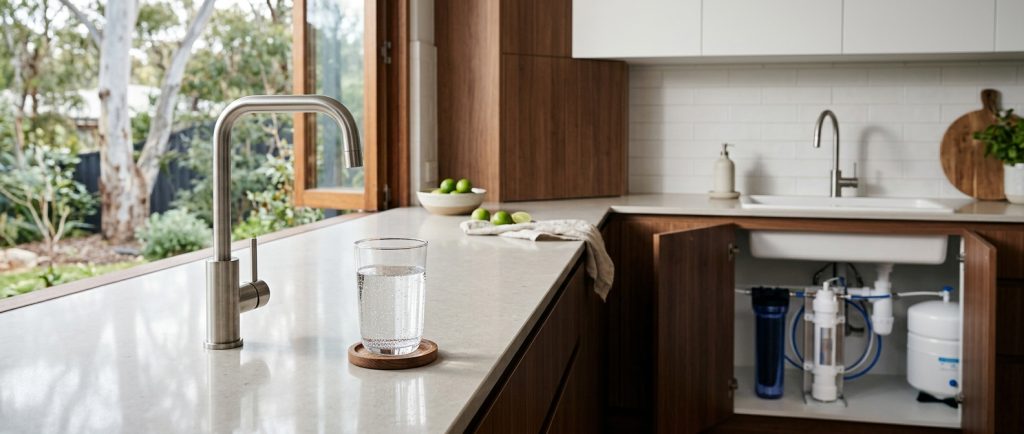
Opting for a drinking water filtration system is not just a matter of buying the most sophisticated filter or selecting the option with the most features. Different systems are designed for different water quality issues, household size, and usage. Australian homeowners should know these differences so that choosing a solution that provides effective filtration is easier.
This guide outlines the key considerations when evaluating filtration systems, including filtration technology, contaminant reduction, certification, maintenance, installation, and long-term value.
Start With Your Water Quality Needs
Before comparing various filtration systems, you must first define your objectives or what exactly you want the filtration to accomplish. A filter whose primary purpose is to improve taste and odor may bear no resemblance to one designed to reduce impurities.
Water supplied through the Australian mains system undergoes purification and treatment. However, there can still be variations in the water’s taste, smell, impurities, or characteristics, depending on the location and the specific plumbing systems one uses.
When you understand the specific problem at hand, the purchasing process becomes much easier. For instance, rather than asking yourself, “Which filter is the best?” you may rephrase the question to, “Which filter is most efficient in addressing my specific water quality problems?”
Point-of-Use or Whole-House Filtration?
Water filtration systems can vary in their filtration methods, but the process remains the same: treating tap water before it reaches the kitchen. In this case, filtered water is required primarily for drinking and cooking.
Whole-house filtering works on a different principle. It works by treating all water entering a household in advance, providing filtered water for other outages like bathrooms, laundry rooms, and kitchens.
In most cases, point-of-use filtration systems are enough for different households. People can save money by knowing what they need in the first place.
Understanding the Main Filtration Technologies
By knowing how different filtration technologies work, homeowners can make an informed choice.
Activated Carbon Filtration
Widely used in homes, activated carbon is well known for its ability to improve taste, eliminate odor, and effectively reduce chlorine. It works on the principle of adsorption, whereby certain elements become trapped on the surface of the carbon as the matter passes through water.
Carbon is usually cheap, small, and simple to use. However, different filtration methods may involve specific designs or types of carbon materials.
Therefore, homeowners should check exactly what technology is used in the carbon filtration process, along with its guarantees.
Reverse Osmosis
Reverse osmosis is a method of filtration in which water is forced to permeate a semipermeable filter under pressure.
This way, reverse osmosis is considered suitable for removing a larger number of dissolved substances that can remain in water after conventional carbon filtration.
They can also produce wastewater during filtration, so homeowners should consider both the benefits and practical requirements before choosing one.
Sediment Filtration
Sediment filters remove suspended solids from water, including dirt, sand, and rust. Sediment filtration is often used as a pretreatment process before using more advanced water filtration systems.
Even though sediment filtration cannot remove a wide variety of impurities, it can still help subsequent filtration stages operate more effectively.
UV Water Filtration
UV filtration uses ultraviolet light rather than a physical filter cartridge to help inactivate microorganisms such as bacteria and viruses. It can be particularly relevant for households using untreated or private water sources, including some bore and rainwater systems.
UV does not remove dissolved chemicals, chlorine, heavy metals, or sediment. For this reason, it is often used alongside other filtration stages rather than as a complete standalone drinking water filtration system. A pre-filter may also be needed to keep sediment from reducing UV effectiveness.
Carbon Filtration vs. Reverse Osmosis
The two technologies that are commonly evaluated when comparing household drinking water systems are activated carbon and reverse osmosis. They are not directly comparable because they are intended for different types of filtration needs.
Carbon filtration is a viable option when chlorine, taste, odor, or specific impurities are the main concerns. It is usually a basic, easy-to-maintain method.
On the other hand, reverse osmosis technology offers more thorough filtration and eliminates more dissolved substances. This technology is appealing to many householders who are concerned about specific impurities in their drinking water. The decision on which filtration method to use depends on the buyer’s objectives. More advanced technology is not better if its treatment process is unnecessary for the water quality in the buyer’s residence.
What to Check Before Buying a Filtration System
A product description can easily make any filtration system sound appealing, but the homeowner should avoid vague claims such as “cutting-edge purification” or “multiple stages of filtration.”
Verify Contaminants Listed
It is crucial to check for specified contaminants and performance-related information. If you are particularly worried about chlorine removal, check whether the product is certified for this particular task. If you are worried about lead, PFOA, or fluoride, make sure the filter has been tested for that contaminant.
Take into account filtration capacity and flow rate.
The filtration capacity indicates how much water a cartridge can treat before it needs to be replaced. The flow rate indicates how efficient the system is. If several people use the kitchen on a day-to-day basis, a practical flow rate is very important.
Check for Replacement Procedure
The cost of the system is not the only expense involved in the purchasing process. Find out how often cartridges or membranes need to be changed and whether replacement cartridges are sold in Australia.
Why Certification Should Be Part of Your Evaluation
Certification represents another aspect of filtration products that ought to be compared. Rather than relying solely on advertisements, the homeowner can assess performance through recognized testing.
Normally, NSF/ANSI standards are cited when discussing water filtration. For instance, NSF/ANSI 42 is a standard that addresses aesthetic issues such as chlorine, taste, and odor, while NSF/ANSI 53 addresses the reduction of health-related pollutants. NSF/ANSI 58 applies to RO drinking water treatment systems.
The homeowner should always be aware of the scope of the certification. A product does not mean it will eliminate every pollutant. Australian buyers should also check Australian legislation and supplier specifications.
Matching a System to Australian Household Conditions
The water requirements of different households in Australia can vary widely. For instance, Melbourne’s water supply is obtained from protected catchment areas, which are treated before being supplied to the consumers. However, it is still possible for homeowners to opt for filtration that improves taste, limits chlorine, or offers other forms of treatment.
When it comes to filtration systems for homes using rainwater tanks, private bores, or other non-mains water supplies, water testing is extremely useful for choosing a particular filtration technology.
Hence, homeowners must avoid choosing drinking water filtration systems simply because they are popular or advertised.
How to Compare Filtration Performance in Real-World Use
Households must evaluate the performance of water filtration systems under typical household conditions rather than simply by the number of filtration stages. Homeowners need to pay attention to the contaminants targeted by the system, its flow rate, and the specific conditions under which the system is qualified to operate.
A system with multiple filter stages is not inherently superior to a simpler model. The main question is whether the filtration process meets the home’s specific water quality needs. A comparison between water filtration systems can be made easier by checking the design specifications and known performance of each.
Maintenance Can Influence Your Filtration Results
Consistent maintenance is crucial to ensure that filtration systems function correctly. Filter cartridges slowly accumulate contaminants, while reverse osmosis membranes also require periodic replacement over the long term.
The need for maintenance depends on factors such as the type of system, the family’s water consumption, and the manufacturer’s recommendations. A large family may need to replace filter cartridges more often compared to a small family.
Importance of Cartridge Replacement
Storing a cartridge beyond its lifespan can affect water filtration and flow. Therefore, homeowners need to track filter lifespan rather than waiting until the water tastes unpleasant.
Routine replacement facilitates regular filtration maintenance and reduces the risk of unnecessary issues with the system.
Installation Can Affect Everyday Convenience
Before buying a drinking water filter, it is necessary to check the installation requirements. An under-sink filter may require sufficient space in a cabinet and proper plumbing connections. In contrast, a reverse osmosis filter may require a larger tank and additional components.
One of the benefits of hiring professionals is that you can be sure that all connections are tight and the device is working properly. Their work will also help people carry out future filter replacements more easily, as they will install the equipment in an easily accessible place.
Installation is not only about making the filter work quickly; it should also enable easy maintenance in the future.
What Does a Drinking Water Filtration System Cost Over Time?
The initial purchase price is useful, but it should not be the only financial consideration. Homeowners should calculate the approximate cost of owning the system over several years.
The total cost may include:
- Initial filtration equipment
- Professional installation
- Replacement cartridges
- Reverse osmosis membrane replacement
- Additional fittings or components
- Periodic servicing
A basic carbon system may have relatively low upfront and maintenance costs, while a reverse osmosis system generally involves more components and potentially higher ongoing expenses.
However, a higher purchase price does not automatically mean poorer value. If a system provides filtration that matches a specific household requirement and operates reliably for years, the overall value may be better than repeatedly purchasing cheaper products that do not meet the same needs.
Comparing Convenience with Filtration Capability
While a filtering system can be exceptional in terms of performance, it must also be usable in daily life. One must check how easy it is to change the filter, how quickly the system produces water, whether it requires electricity, and whether it has a tank.
For an installation under the sink, cabinet space is the most important factor. Homeowners must be able to maintain the system without undue difficulty.
Usually, the best system is the one that fits the household’s needs.
When a Simple Filtration System May Be Enough
Not every homeowner requires a sophisticated filtration system. If the primary objective is to eliminate chlorine odor and taste or improve water taste, a good activated carbon solution may be an adequate option.
Chlorine is not the only disinfectant that can affect the taste and odor of drinking water. Some water supplies may also use chloramine, a combination of chlorine and ammonia. Standard carbon filters can reduce some chloramine, but performance varies by filter design and contact time. Homeowners who specifically want chloramine reduction should check the manufacturer’s test results rather than assuming a standard carbon cartridge will remove it effectively.
These systems are generally compact and easy to maintain. They are especially appropriate for small homes and apartments, as well as for people who primarily need filtered water for drinking and cooking.
Nevertheless, performance varies by cartridge in each device, so homeowners need to ensure that the device is certified or tested to remove the specific contaminants.
When Advanced Filtration May Be Worth Considering
Advanced filtration may be an important weapon in a homeowner’s arsenal if they want to thoroughly clean water or address a more serious water issue that basic carbon filters cannot manage.
Reverse Osmosis Technology
Reverse osmosis relies on a special kind of membrane that separates water from the solutions being treated. Therefore, it could be an important consideration when homeowners need more advanced filtering methods.
Nevertheless, RO systems are usually more sophisticated and may require more maintenance, more storage space, and replacement parts. So, the homeowner must decide whether they need a filtering system more complex than a basic carbon filter.
One trade-off with reverse osmosis is water efficiency. RO systems reject some water during the purification process, so the exact amount depends on the system’s design and efficiency. As a general example, older or less efficient systems can discharge several liters of water for every liter of purified water produced. At the same time, modern high-efficiency models can use considerably less. It is therefore worth checking the product’s recovery or wastewater ratio before buying.
Another consideration is mineral removal. Because reverse osmosis reduces many dissolved substances, it can also remove minerals such as calcium and magnesium from the treated water. This is not necessarily a disadvantage for everyone, but homeowners who prefer mineral-containing water naturally may want to consider this factor when comparing RO with other filtration methods.
How to Build a Practical Filtration Buying Checklist
Before purchasing a system, it helps to create a simple checklist. This prevents homeowners from making a decision based only on price, appearance, or online reviews.
Build a Practical Buying Checklist
Homeowners can assess several key points before acquiring a filtration system to avoid relying on price or advertising.
Establish the Filtration Objective
To begin with, clarify what the system needs to improve. These may refer to any of the following issues: the presence of chlorine in water, its flavor, sediments, or other pollutants.
Examine Performance Claims
Consult the manufacturer’s literature and credentials to find out which substances the system is designed to eliminate. The assumption that all multi-stage filters remove the same contaminants can prove wrong.
Establish Long-Term Cost Estimates
Consider the cost of cartridges, replacement frequency, installation costs, and maintenance costs. This will make the actual cost of ownership much clearer.
Investigate Installation
Ensure there is enough free space and plumbing connectivity. This is especially true for under-sink and reverse osmosis systems.
Investigate Replacement Filter Availability
Replacement cartridges must be easily found on the Australian market. It becomes impractical if the filter is hard to find or too expensive.
When Water Testing Can Help
Water testing is crucial when you discover changes in taste, smell, color, or dirt in your water supply. It is even more significant for those properties that rely on rainwater tanks or groundwater as their private water supply.
For water from regulated mains, water testing for every household may not be necessary. Still, it comes in handy for those who want to filter water based on real data rather than mere guesswork when they are concerned about some contamination.
Thus, water testing might help homeowners avoid the effects of both under- and over-filtration.
Final Thoughts
When selecting water filter systems, it is essential to begin with your water’s quality requirements. Use reliable data and evidence-based claims to compare the filtration methods and their effectiveness in performance, equipment maintenance, installation, and long-term costs.
A properly selected system can provide the type of filtration you require and avoid unnecessary expenses and hassles.