_edited_9.png)
Table of Contents
Introduction
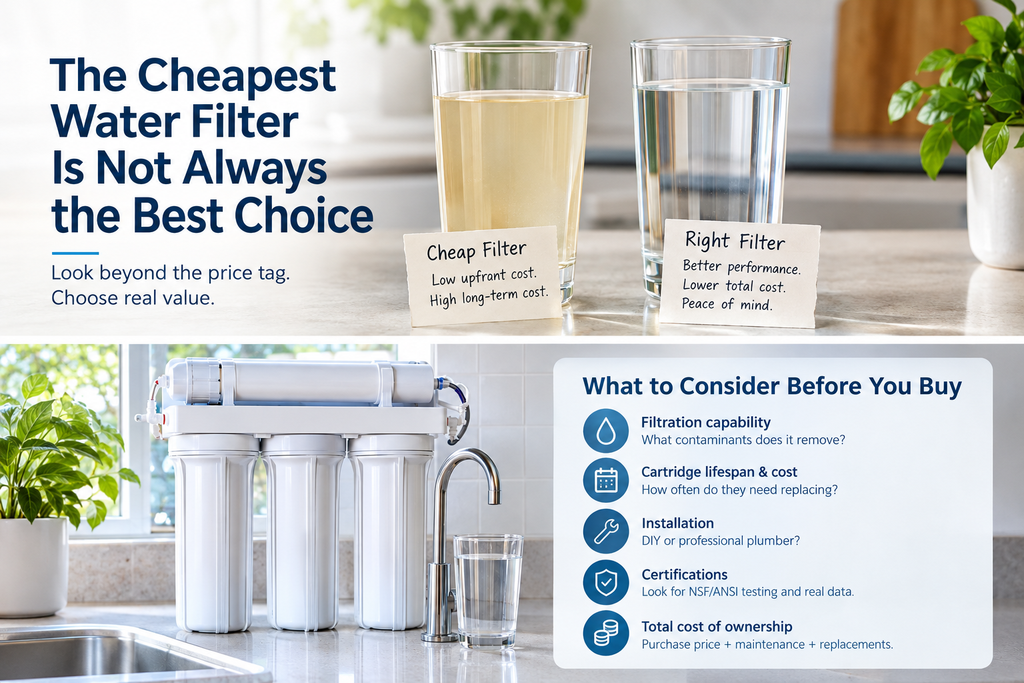
Want to spend less on water filtration? Just find the least expensive filter available.
It sounds like a great idea until you discover that the money-saving decision comes with a much higher price tag down the line. Frequent cartridge replacements, maintenance issues, ineffective filtration, installation problems, and eventually an entirely new system all add up quickly.
The lowest-priced water filtration system may actually be the most expensive option in the long run, helping homeowners feel assured they are making a wise investment.
The Cheapest Water Filtration System Looks Brilliant Until You Use It
Price is usually the first thing that stands out when comparing water filters. A lower-priced model looks tempting, especially when two systems appear similar on the surface.
Water filtration is more complicated than simply placing a device between the tap and the glass. Different systems address different contaminants and are designed for different purposes. A cheaper filter is not automatically a worse filter; the problem arises when homeowners expect it to do far more than it was designed for.
A filter intended purely for taste improvement and chlorine reduction will not perform adequately for someone who needs broader contaminant removal. The more important question is not “how cheap is it?” but “what will it actually remove?”
Why Cheap Filters Are So Tempting for Australian Homeowners
It is perfectly natural to look for affordable options. Comparing prices before buying is a sensible approach to household spending.
The problem arises when price becomes the only criterion.
Australian households have different filtration needs depending on their local water supply, property type, and location, empowering homeowners to make informed decisions based on their specific water conditions.
Before settling on the cheapest option, consider:
- Filter longevity: Less expensive filters often require more frequent cartridge changes
- Filtration efficiency: Some lower-priced systems reach their capacity quickly and need maintenance sooner than expected
- Cartridge availability: A cheap system delivers little ongoing value if replacement cartridges are hard to source or unexpectedly expensive
- Installation requirements: Some systems require additional fittings or professional plumbing work that adds to the total cost
- Filtration capability: The system must actually address the specific contaminants in your water supply
Saving $100 upfront sounds appealing. Spending significantly more than that over the following two years on replacements and workarounds does not.
The Hidden Cost of Buying a Filter That Is Too Cheap
The purchase price is only one part of the total cost of owning a filtration system.
A low-cost purchase can seem like a bargain at the point of sale, only to reveal six months later that its replacement cartridges are expensive and need changing more frequently than anticipated. At that point, the “cheap” system is no longer cheap.
The correct way to compare filtration systems is by total cost of ownership, not retail price alone.
For example, a $300 filter may initially appear cheaper than a $500 system. But if the $300 system requires $100 cartridges every three months, its two-year cost will significantly exceed that of the $500 system, which uses longer-lasting, more affordable cartridges.
The right comparison should always include:
Purchase price + installation + cartridge replacements + servicing + expected system lifespan
A system with a slightly higher upfront cost that uses long-life cartridges and requires minimal servicing will frequently cost less over three to five years than a cheaper system that demands constant attention.
A low purchase price does not mean low operating costs.
Filtration Performance: What Are You Actually Paying For?
When evaluating water filters, filtration capability matters far more than the discount applied to the price.
Different filtration technologies serve different purposes. Activated carbon, sediment filtration, and reverse osmosis systems each address different types of contaminants and are suited to different household needs. A system designed for one purpose will not substitute effectively for another.
Chloramine is worth particular attention when comparing carbon-based filters. Not every carbon filter reduces chloramine effectively; standard activated carbon performs well against free chlorine but may not remove chloramine to the same extent. Catalytic carbon media is specifically designed for chloramine reduction. Check the manufacturer’s independently tested performance claims rather than assuming all carbon filters perform identically.
Before purchasing any system, review:
- What contaminants the manufacturer claims the system removes
- Whether those claims are supported by independent certification or test data
- The specific performance levels achieved during testing
Be cautious of vague marketing language like “pure water,” “advanced purification,” or “removes all contaminants.” These phrases carry no technical weight without supporting data. A reliable filtration product will provide clear, specific information about what it is designed to do and how well it has been independently tested to do it.
Why the Right Filter Matters More Than the Cheapest Filter
The most suitable filter for one household may be entirely wrong for another.
A homeowner who wants improved taste and reduced chlorine has very different needs from one who wants comprehensive contaminant removal for their family’s drinking water. Starting with the water problem rather than the price point leads to a much better long-term decision.
Before comparing prices, answer these questions:
- What specific problem do I want the filter to address?
- Do I need filtered water at one tap or throughout the entire property?
- How much water does my household use daily?
- How reliably will I stick to a maintenance and replacement schedule?
Once you know what you actually need, finding a system at a fair price within that category becomes a much more straightforward comparison.
Cheap Installation Can Create Expensive Problems
Even a quality filtration system will underperform if installed incorrectly. Poor installation can cause leaks, incorrect connections, reduced water flow, and damage to the system itself, all of which add unexpected costs well beyond the original purchase price.
In Australia, any filtration system connected to household water supply lines should be installed by a licensed plumber to ensure safety and reliability, providing homeowners with peace of mind and helping avoid costly mistakes.
When comparing filtration systems, find out whether installation is included in the price, what additional plumbing components are required, and whether professional installation is recommended or legally required for that system type. A slightly higher upfront cost that includes proper installation often saves considerably more in avoided water damage and rectification work down the line.
A Smarter Way to Compare Cheap and Quality Filtration Systems
You do not need to spend a large amount of money on a water filtration system. You do need to evaluate the right factors before deciding.
Before making a purchase, consider:
- What contaminants is the system independently certified to reduce?
- How often do cartridges need to be replaced, and at what cost?
- How straightforward is installation, and does it require a licensed plumber?
- Are replacement cartridges readily available from local suppliers?
- Does the manufacturer provide ongoing technical support and warranty coverage?
- Will this system genuinely meet my household’s specific water quality needs?
After honestly evaluating these factors, the least expensive option may still come out ahead, or it may not. The goal is not to avoid inexpensive filters; the goal is to avoid choosing a filter based solely on the number on the price tag.
An effective filtration system provides a reasonable balance between purchase price, filtration performance, maintenance requirements, and total cost of ownership over its working life.
The Real Price of a Water Filter Starts After You Buy It
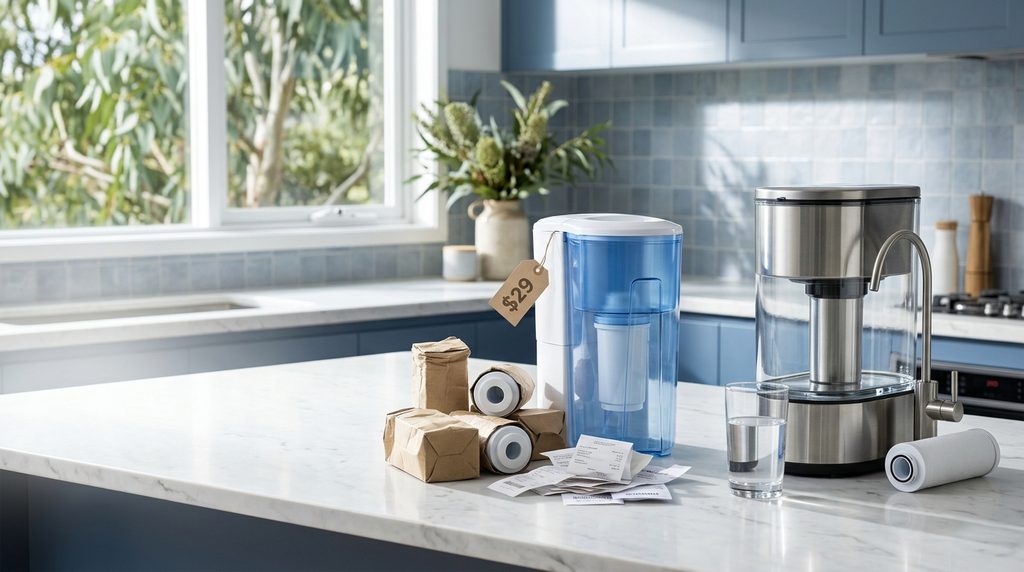
The purchase itself is just the beginning. The real challenge becomes apparent several months later when it is time to replace the cartridge and service the system.
This is when many “inexpensive” purchases reveal their true cost. The initial low price can seem genuinely attractive right up until the ongoing replacement and maintenance costs are added to the total.
Before committing to a system, find out the cost of replacement cartridges, how long they are likely to last at your household’s typical water usage, and whether spending slightly more on the system itself would result in lower and less frequent ongoing costs. In many cases, a moderate additional upfront investment pays for itself within the first year of use.
Maintenance Is Part of the Deal
Every filtration system requires regular maintenance. What differs between systems is the frequency, complexity, and cost of that maintenance.
Delaying filter replacement beyond the recommended schedule reduces filtration effectiveness and can affect water flow and quality. The least expensive system to purchase is not always the least demanding to maintain.
Before selecting a system, consider:
- Replacement frequency: How often do cartridges need to be replaced according to the manufacturer?
- Cartridge cost: What is the annual cost of replacement cartridges at the recommended interval?
- Availability: Are compatible replacement cartridges stocked locally, or are they only available through a single supplier?
- Servicing: Does the system require periodic professional servicing in addition to cartridge replacement?
A filtration system that performs reliably and requires straightforward, accessible maintenance will consistently deliver better long-term value than one that demands constant attention or relies on hard-to-source components.
Reverse Osmosis Maintenance Schedule & Common Problems.
Certifications and Claims Matter More Than a Fancy Price Tag
Comparing filtration systems becomes considerably easier when you look past advertising language and examine what the product has actually been tested to do.
Terms like “superior,” “extra pure,” and “state-of-the-art purification” appear frequently in filter marketing but carry no technical meaning without supporting evidence. What matters is specific, verified performance data.
Look for relevant NSF/ANSI certification when comparing products:
- NSF/ANSI 42 covers chlorine, taste, and odor reduction
- NSF/ANSI 53 covers health-related contaminant reduction, including lead and VOCs
- NSF/ANSI 58 covers reverse osmosis system performance
- NSF P473 covers reduction of specific PFAS compounds
Always check what a certification actually covers rather than assuming it means the filter removes every type of contaminant. A filter certified to NSF/ANSI 42 has been tested for chlorine reduction, not for lead, PFAS, or heavy metals.
Finding a reasonably priced filtration system with verified certification and clear performance specifications is a far smarter approach than paying a premium for impressive-sounding marketing language with no supporting evidence.
When Is a Cheap Water Filter Actually a Good Choice?
Here is something the “never buy cheap” argument often overlooks: in some situations, an inexpensive filter is genuinely the right choice.
If your filtration needs are straightforward and the product is properly suited to those needs, there is no reason to spend more than necessary. A simple activated carbon filter may be entirely adequate if your goal is to improve taste and reduce chlorine at a single kitchen tap. For a renter in a small apartment with no specific contaminant concerns, a basic system can deliver the necessary improvement at minimal cost.
The issue is not buying an inexpensive system; it is buying an inexpensive system and expecting it to deliver results it was never designed to provide. Match the system to the need, and a lower-cost option can represent genuinely good value.
Choose Value, Not Just the Lowest Number
The most affordable water filtration system is not the one with the lowest purchase price; it is the one with the lowest reasonable total cost for the level of performance your household actually needs.
Compare the purchase price and cartridge replacement costs, along with the expected system lifespan, installation requirements, and ongoing support availability. Consider how well the system genuinely addresses your home’s specific water quality concern, not just how it compares on a price list.
For Australian homeowners, this is particularly relevant because filtration needs vary considerably by location, property age, and household size. What works well for a household in one area may not be the most appropriate or cost-effective choice for yours.
Companies like Demand Filtration can help homeowners understand their options before making a purchase based solely on price. The first and most important step is identifying your specific water quality concern, then finding the right system to address it at a fair long-term cost.
The Cheapest Filter Is Not Always the Cheapest Decision
Saving money is entirely sensible. The question is whether the saving is real.
A genuinely money-saving water filtration system delivers the performance you need without generating unnecessary installation, maintenance, or replacement costs down the line.
Before choosing the cheapest filter on the shelf, ask yourself honestly: “Have I actually saved money, or have I simply deferred the cost?”
If you can answer that with confidence, you are already making a more informed decision than most people do when they reach for the lowest price tag.
Conclusion
The lowest-priced filter is not always the best long-term choice. When selecting a water filtration system, evaluate filtration capability, cartridge lifespan, maintenance requirements, replacement costs, certification, and overall reliability, not just the number on the price tag.
Finding genuine value in a water filter means choosing a system that does what it is supposed to do, is practical to maintain, and delivers a lower total cost of ownership over time than the alternatives. Sometimes that system is affordable. The key is knowing the difference before you buy.