
Table of Contents
Melbourne Water Hardness Explained: Water Quality, Minerals, and Testing
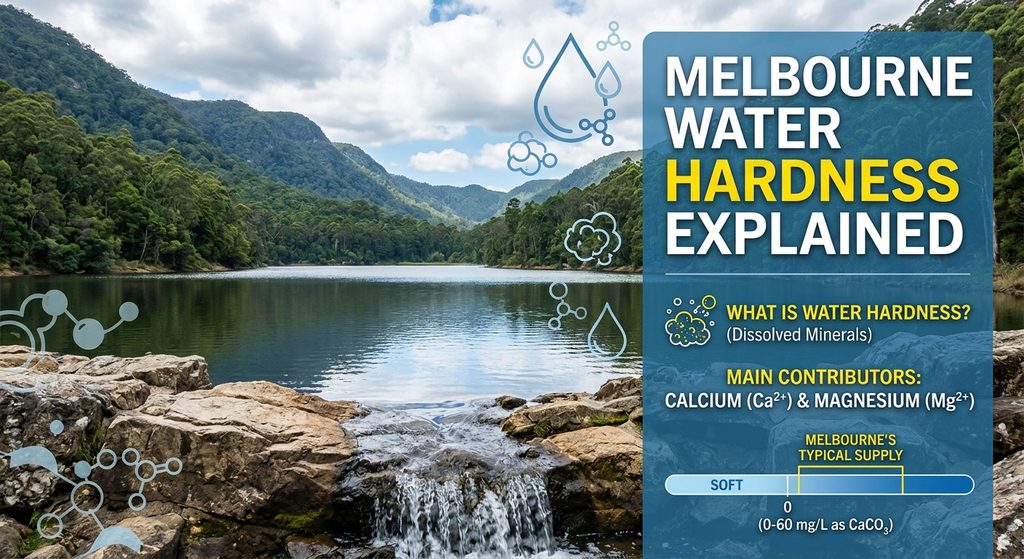
Water hardness affects how tap water tastes, how much mineral buildup forms on fixtures, and how efficiently household appliances run. Melbourne water hardness refers to the concentration of dissolved minerals, mainly calcium and magnesium, in the drinking water supply. When residents understand these mineral levels, they can better judge how their water behaves at home.
Melbourne draws its water from several sources, so mineral concentrations vary. This guide explains how hardness works, what influences it, and how to test it.
What Is Water Hardness and Why Does It Matter?
Minerals enter water naturally as rainwater moves through soil, rock, and underground geological formations. As it travels, small amounts of those minerals dissolve into the water.
The amount of calcium and magnesium determines whether water is classed as soft, moderately hard, or hard. Water with low mineral concentrations is soft. This difference affects how soap behaves, whether mineral deposits form on household surfaces, and how some appliances perform over time.
Read More: How Hard Water Affects Your Home and Health
It is important to remember that hardness is only one measure of water quality. It does not tell you whether water is safe to drink, whether it contains microorganisms, or whether it contains chemical contaminants. A full picture of water quality means looking at several other measurements too.
The Difference Between Hard Water and Soft Water
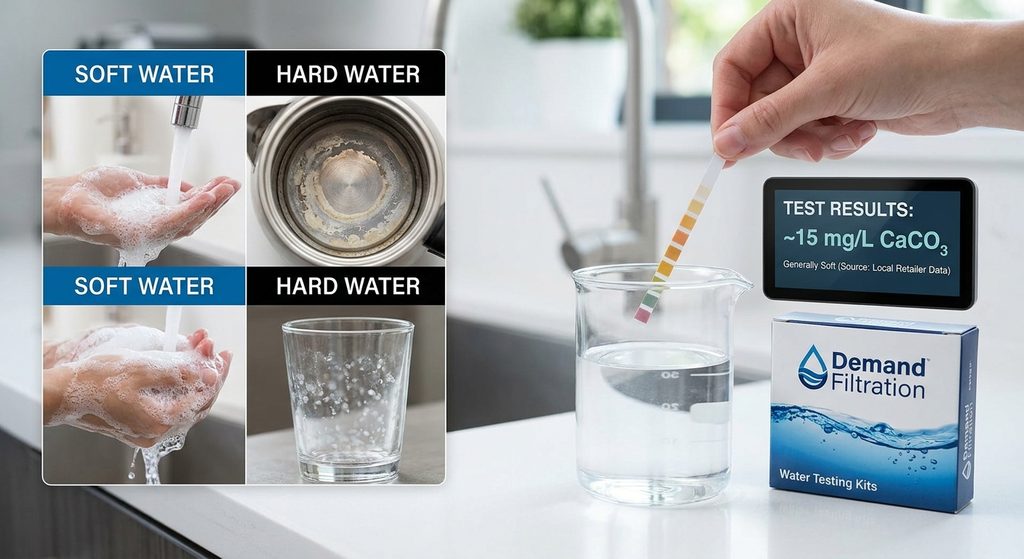
Soft water has lower concentrations of dissolved calcium and magnesium. Soap lathers more easily, and there is less mineral buildup on taps, shower screens, and heating elements.
Hard water has higher concentrations of these minerals. When it is heated or evaporates, it leaves mineral deposits behind, commonly known as limescale. This shows up as white marks and stains on taps, kettles, and other surfaces that contact the water.
Neither term means one type is bad and the other good. Hardness describes mineral content and its practical effects on household items. Some people prefer the taste of harder, mineral-rich water, while others prefer the clean taste of soft water.
Why Water Hardness Is Different from Overall Water Quality
Water quality has many components, including pH, turbidity, metal concentrations, disinfectant levels, and the presence of specific contaminants. Hardness measures only the dissolved calcium and magnesium.
Water can have low hardness and still need disinfection and monitoring. Equally, water with high mineral content can still be fit to drink if it meets drinking water standards.
This distinction matters when interpreting Melbourne’s water hardness data. A hardness result should never be treated as a water safety assessment.
Is Melbourne Water Generally Soft or Hard?
Published supply data shows that several of Melbourne’s reservoirs have very low hardness. In standard classifications, water below 60 mg/L as calcium carbonate is generally considered soft.
However, reservoir readings do not represent the hardness at every tap across metropolitan Melbourne, because water reaching a property may come from different sources and pass through different treatment and distribution processes. It is more accurate to describe Melbourne’s major source waters as generally low in hardness while recognizing that local results should be checked separately.
This information helps residents decide whether any home water treatment is actually needed.
Which Minerals Make Melbourne Water Hard or Soft?
Calcium and magnesium are the minerals that determine water hardness. Both occur naturally and dissolve into water as it moves through geological materials. Their combined concentration determines total hardness.
Mineral concentrations differ between water types. Surface water from protected catchments has a different mineral profile from groundwater, which spends longer in contact with underground rock. Treatment processes and the blending of different supplies can also change the final product.
Calcium: A Major Contributor to Water Hardness
Calcium is found in rocks, soil, and many water sources. When rainwater and surface water contact calcium-containing materials such as limestone, calcium dissolves into the water.
In drinking water, calcium contributes to hardness, and high concentrations can lead to limescale deposits when the water is heated.
Calcium is an important nutrient in the human diet, but the calcium in tap water should be seen as part of its mineral content rather than as a significant nutritional source.
Magnesium: Another Important Hardness Mineral
Magnesium also contributes to hardness. It dissolves into water when it contacts rocks and soils containing magnesium minerals, and like calcium, it adds to the overall mineral content.
When both minerals are present, their proportions influence how water reacts with soap and how mineral deposits form. The split between calcium and magnesium can vary by source even when total hardness is similar.
For that reason, a mineral analysis can sometimes be more informative than a total hardness test alone, because it shows the calcium and magnesium proportions.
Do Other Minerals Affect Water Hardness?
Calcium and magnesium account for most water hardness. Trace amounts of other dissolved elements, such as iron, manganese, strontium, and barium, can contribute slightly.
Not every mineral in a water sample counts towards hardness. Sodium and potassium, for example, are dissolved minerals but are normally excluded from total hardness calculations.
This is worth remembering when reading a water test report. A high total mineral content does not necessarily mean high hardness unless the minerals present are the ones that cause it.
Understanding Melbourne Water Hardness Levels
Melbourne’s drinking water comes from a network of treatment plants, reservoirs, and distribution systems, so its mineral content is not identical in every suburb or home.
Melbourne Water’s published data shows that hardness varies between reservoirs. For example, the Upper Yarra records approximately 9 to 14 mg/L, while Tarago records approximately 27 to 38 mg/L, both as calcium carbonate. These figures describe source water, not guaranteed readings for every household tap.
Source: Melbourne Water, Water Quality Testing.
These readings give a useful picture of Melbourne’s water, but they should not be assumed to apply to every tap in the city. Supplies can be blended, and quality can vary in some areas because of specific distribution arrangements.
Who Supplies Water to Melbourne Homes?
Melbourne Water is the wholesale supplier. Three retailers deliver water to households: Yarra Valley Water, South East Water, and Greater Western Water. Each serves a different part of metropolitan Melbourne and publishes local water quality information. Residents should check their own retailer’s reports for supply-specific details rather than relying only on general reservoir data.
Why Hardness Can Vary Between Melbourne Suburbs
Water reaching different Melbourne suburbs can come from different parts of the supply network, depending on the retailer, the sampling point, and the source.
Hardness varies between supply zones. Available zone data shows readings from approximately 6 to 57 mg/L as calcium carbonate. For example, Braemar Road records around 12 mg/L, Doncaster 16 mg/L, Craigieburn 19 mg/L, and Bundoora 26 mg/L. These are location-specific measurements, not guaranteed readings for every property, so check your retailer’s latest report for the most accurate figures.
To understand your own water hardness, identify your water retailer and read the published data for your area. A household hardness test can also confirm what is coming from your tap.
How Melbourne Water Hardness Affects Everyday Household Activities
Melbourne’s water is generally soft, but understanding its composition still helps explain common household observations. Hardness affects how well soap works, how cleaning behaves, and how readily mineral deposits form. These effects are more pronounced where calcium and magnesium concentrations are higher.
Effects on Soap, Shampoo, and Cleaning Products
Hard water makes it harder for soap to produce a rich lather. Calcium and magnesium react with some soap compounds, which reduces cleaning effectiveness and can leave residue on skin, hair, and bathroom surfaces.
With lower hardness, soap and detergent generally work more easily, which can reduce the amount of cleaning product needed for everyday washing.
Can Very Soft Water Cause Problems?
Very soft water can contribute to plumbing corrosion, particularly when pH and alkalinity are also low, which may increase the chance of metals entering the water from pipes. Low hardness alone does not mean water is unsafe, but other water chemistry factors should be considered alongside it.
Mineral Deposits in Kettles and Hot Water Systems
Limescale forms when hard water is heated, and over time minerals can leave white rings in kettles and on taps. Melbourne’s water is not very hard, so these problems are less frequent than in harder water areas. Existing deposits may still come from other minerals or from plumbing conditions.
Does Water Hardness Affect Drinking Water Taste?
Calcium and magnesium influence the taste of drinking water. Some people find mineral-rich water slightly fuller in taste, while soft water tastes lighter.
Taste alone is not a reliable way to judge hardness, however. Temperature, pH, dissolved substances, and disinfectants can all strongly affect how water tastes.
Chloramine and Other Water Quality Factors to Understand
Hardness is only one part of drinking water quality in Melbourne. Disinfection is another essential part of the process, controlling microbial contamination and keeping water safe throughout the supply system.
What Is Chloramine and Why Is It Used?
Chloramine is a disinfectant made by combining chlorine with ammonia. Water suppliers may use it to keep water safe as it travels through pipes.
Unlike hardness, which comes from calcium and magnesium, chloramine does not contribute to hardness. It can, however, affect taste and smell, and some residents confuse the taste of disinfectant with a mineral taste.
According to Melbourne Water, chlorine, chloramine, and ultraviolet light are among the disinfection methods used in its water treatment.
Why Hardness and Disinfection Should Be Checked Separately
A hardness test reflects mineral content, not disinfectant levels or microbiological safety. A low hardness result therefore does not mean other water quality parameters are within their required ranges.
Residents should view hardness alongside what they know about chlorine, chloramine, pH, and other water quality measures.
How to Test Melbourne Water Hardness at Home
Testing helps you understand the mineral characteristics of your water rather than relying on assumptions from taste or visible deposits.
Use a Water Hardness Test Kit
Home hardness test kits come as strips or liquid tests. Most give a general reading that indicates whether water is soft, moderately hard, or hard.
Follow the product instructions, use a fresh water sample, and check the unit of measurement first. Some kits report mg/L as calcium carbonate, while others use degrees of hardness.
Get a More Accurate Laboratory Test
For more detailed results, use a NATA-accredited laboratory to test total hardness, calcium, and magnesium. EDTA titration is a recognised method for measuring total hardness. Follow the laboratory’s sample collection instructions so that results are accurate.
Laboratory testing is especially helpful for households with a private bore, a rainwater supply, or other specific water quality concerns.
Should Melbourne Residents Install a Water Softener?
A water softener removes the minerals that cause hardness, usually through ion exchange, which replaces calcium and magnesium ions with sodium or potassium ions.
Because most of Melbourne’s water sources have low hardness, many households do not need a dedicated water softener. Before investing in one, check your actual water hardness and confirm that mineral deposits are a genuine problem.
Keep in mind that a softener does not remove other substances such as chlorine, chloramine, PFAS, or microorganisms.
Frequently Asked Questions
Is Melbourne tap water hard or soft?
Generally soft. Melbourne Water’s published reservoir data shows hardness well below 60 mg/L as calcium carbonate, though local readings vary by supply zone.
Do I need a water softener in Melbourne?
Usually not. Most households have low hardness, so a softener is rarely needed. Confirm your local hardness first.
Why do I still get limescale on my kettle in Melbourne?
Even soft water can leave deposits over time, particularly with frequent heating. Older plumbing or local supply variations can also contribute. A hardness test can confirm whether hardness is the cause.
Does a low hardness reading mean my water is safe?
No. Hardness measures only calcium and magnesium. Water safety depends on microbiological, chemical, and other physical quality parameters.
Final Thoughts on Melbourne Water Hardness and Water Quality
Understanding Melbourne water hardness helps residents learn more about their household water, mineral deposits, and treatment options. Most of Melbourne’s supplies have low hardness, but local retailers and piping infrastructure can still influence the water at your tap.
Rather than relying on assumptions, consult real water quality data and test your own water when needed. Once you understand the mineral concentration, the disinfectant used, and other water quality factors, you can take appropriate action with confidence.