_edited_9.png)
Table of Contents
INTRODUCTION:
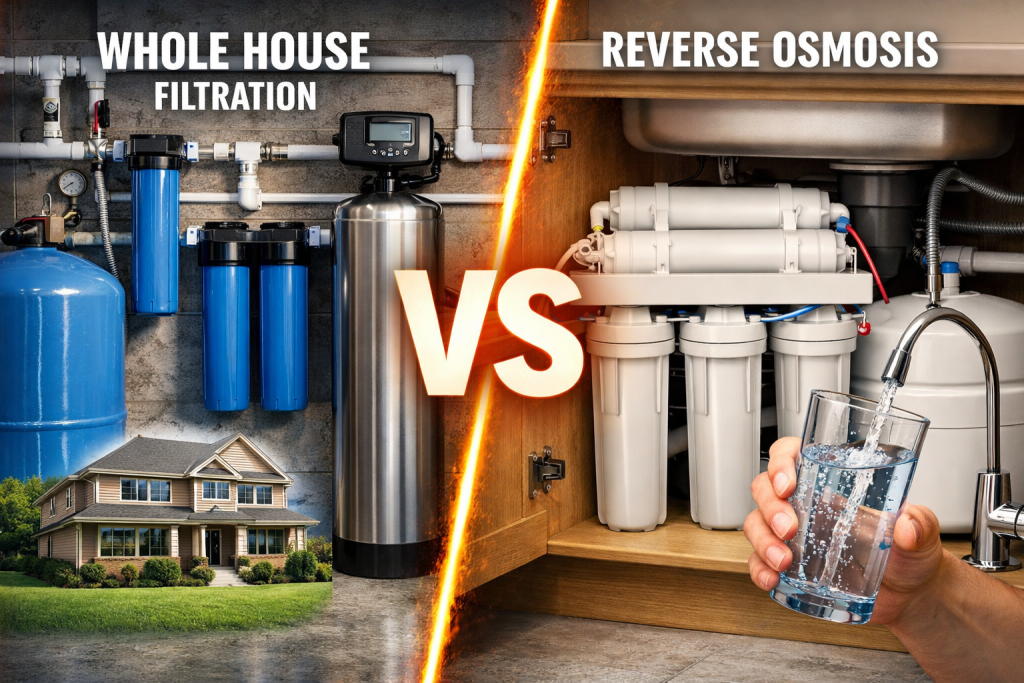
This article provides an overview of the ways in which whole-house filtration and reverse osmosis differ from each other to help customers in Australia. Clearly understand these two popular water treatment methods and choose the best option for their home. Both of these systems treat water for better quality.
However, they do so in very different ways and serve different needs. The advertising for each system makes it difficult for many customers to see the difference between them, as these advertisements often focus solely on the benefits of both systems without providing details on the limitations connected with each, their suitability for a particular situation, or the potential of long-term use.
This guide is designed to provide the reader with a thorough understanding of each type of filtration method in terms of how they operate, and where the advantages and disadvantages exist, so that you can make an informed decision based on the way you use water, the style of your home, the way you live, and your water needs.
Understanding Whole House Filtration Systems
Whole-house water filtration systems filter all of the incoming water to a home at the point of entry. This allows all fixtures and appliances in the home to use the same filtered water, ensuring the same water quality throughout the home.
In Australia, many homeowners select a whole-house filtration system because they wish to improve the quality of their entire home’s water, rather than only improving the water designated for drinking purposes.
How Whole House Filtration Works
Most whole-house filter systems employ a multi-stage method of treatment rather than using ultra-fine particle separation as described above. Water passes through several filters prior to entering any of the household plumbing, where sediment, chlorine, odors, and certain chemical contaminants are removed.
Some common filtration stages are:
1) Sediment filtration – It captures dirt, sand, rust, and pipe debris, which often occur in older infrastructures.
2) Carbon-based filtration – Where chlorine, bad taste, and organic compounds are reduced, and improved water quality.
3) Optional specialty media – The use of which varies based on local water chemistry, depending on whether they employ scale inhibitors or heavy metals treatment.
It is evident that these systems provide a balanced approach to overall water quality improvement while still maintaining the pressure or flow throughout the entire house.
Where Whole House Filtration Fits Best
Whole-house filtration systems are an excellent way for families to improve the quality of their water as well as the showering experience. The biggest benefit is that homes with several bathrooms will have significantly less chlorine in the shower water, compared to homes without these filtration systems.
These whole-house filtration systems also tend to be very popular in homes, where protecting appliances and extending the life of plumbing fixtures are important.
Understanding Reverse Osmosis Systems
A reverse osmosis system will provide very pure water for a specific use. Unlike a water treatment system, which provides treated water for your entire home, the primary goal of a reverse osmosis system is to produce potable water with a higher level of purity.
How Reverse Osmosis Works
Reverse osmosis uses a semi-permeable membrane to separate water molecules from dissolved solids and contaminants. Water is forced through this membrane, leaving impurities behind.
The basic steps in the Reverse Osmosis process are:
1. Pre-Filtration: This step removes sediment and chlorine that may damage the reverse osmosis membrane.
2. Reverse Osmosis Membrane Filtration: Dissolved salts, heavy metals, and microscopic contaminants are reduced through this filtration.
3. Post-Filtration: The post-filtration stage polishes the purified water before it is used for consumption, improving the taste and clarity.
As a result of the Reverse Osmosis process, the resulting output is a highly purified form of drinking and cooking water.
Where Reverse Osmosis Fits Best
For Australian homeowners who prioritize quality when it comes to drinking water, reverse osmosis systems provide an excellent option. They’re ideal for homeowners who drink significant amounts of water from the tap, particularly those who prepare drinks in their own home or prefer ultra-clean water.
These systems are typically placed under the sink, providing drinking water from one to two outlets.

Coverage Differences: Whole House Filtration vs Reverse Osmosis
The main difference between whole-house systems and Reverse Osmosis systems is the distribution of treated water throughout your home.
Whole House Systems start with the first drop of water coming into your home. Therefore, every time you take a shower, do your laundry, or clean your dishes, the water is coming from the same source. There’s a noticeable difference between this type of installation and reverse osmosis.
Reverse osmosis, on the other hand, delivers purified water only where it is installed. While the water quality is extremely high at that point, the rest of the household continues to receive untreated municipal water.
The Australian homeowner needs to evaluate whether they wish for total coverage or prefer targeted treatment when deciding between these two options.
Water Quality Outcomes and Daily Experience
Taste and Odor Improvement
Whole House Filtration removes chlorine and sediment to provide improved taste and odor for the entire home. The less smoke and sediment the shower has, the softer it is on the skin and hair. Additionally, laundry water will be gentler on fabrics.
The Reverse Osmosis process provides very little dissolved solid content in the final water product, giving it an extremely clean, neutral taste. For many people, this is their preferred method for drinking and cooking, although the primary distinction is seen at the tap where the system is installed.
Impacts on Home Appliances and Plumbing
With a whole-home filter system, appliances are protected from harmful build-up of sediments and chlorine-based wear. Over time, this can lead to a longer functional lifespan of the appliance as well as significantly fewer maintenance-related issues for the owner.
Under most circumstances, reverse osmosis systems do not protect the other appliances within a house because they usually only provide treated water at a jar or spout. As such, the benefits of reverse osmosis systems are generally limited to drinking and cooking.
Installation and Space Considerations
For whole-house filtration systems, professional installation is necessary at the point of water entry into the home. This means that property layout is a factor in these systems. In Australia, homes that have accessible outdoor plumbing or garage-mounted water meters may make installation easier, while homes that are older or are in urban areas may require further adjustments. Sometimes, re-routing or mounting brackets may be necessary, making installation slightly more complicated.
Since these types of systems process all of the incoming water, they are typically a larger system that requires installation in a location with sufficient access space. Additionally, a homeowner will also have to consider future access for maintenance purposes once a whole-house system has been installed.
Reverse osmosis units are compact and usually placed either behind the kitchen sink or in a nearby cabinet. This allows them to easily fit into an apartment, a townhouse, or a house with limited space. Nevertheless, storage for the replacement filters, access to the drain line, and maintenance friendliness must not be overlooked either.
Maintenance and Ongoing Care
Maintenance Requirements for Whole House Filtration
Whole House Filter Maintenance must be performed regularly, and when possible, on a schedule based upon the amount of water used in a household as well as the quality of the water supply. Although the replacement intervals for larger size filters are usually longer, there are many instances where these filters can also be maintained by a qualified technician.
Maintenance Requirements for Reverse Osmosis
The reverse osmosis system utilizes various filters and membranes as components that will need to be replaced regularly. While individual components are often small, this means that each component will need to be maintained at a higher frequency, and the maintenance guidelines must be carefully followed to ensure continued performance.
Both of these systems require that the owner stay committed to maintaining the system in order to provide a constant quality of water over time.
Cost Considerations in Australia
When comparing whole-house filtration systems to reverse osmosis systems for Australian homeowners, cost is a significant factor to consider when making decisions about an initial investment versus future savings.
Due to the larger size of whole-house filtration systems, they tend to have higher up-front costs than reverse osmosis systems because of the larger system size, the need for a professional installer, and the possible need to modify existing plumbing.
Despite having higher up-front costs than reverse osmosis systems, most homeowners feel that the long-term benefits of having a whole-home filtration system are worth the initial expense.
A reverse osmosis system typically costs less than other systems. The majority of your spending will only go toward drinking and cooking water. Other potential costs to consider on an ongoing basis include filter replacements and membrane replacements, particularly if your home has a high demand for drinking and cooking water.
Choosing Between Whole House Filtration and Reverse Osmosis
The decision between whole-house filtration and reverse osmosis systems is based more on the priorities of the family than on the technological superiority of one over the other. Families that place a high value on the quality of water they use for bathing, laundry, cleaning, and protecting appliances typically find that Whole House Filtration is the best long-term investment to improve the quality of water throughout their home.
For those households where drinking water and water for cooking are the main concern, specifically with regard to smaller homes or rental properties, a reverse osmosis system would be a more practical option. To find the best match, several factors should be considered: family size, amount of water consumed each day, space available for installing the unit, and local characteristics of the water supply.
Taking the time to match the capabilities of the system with actual needs will typically yield greater satisfaction and reduce potential dissatisfaction in the long term.
Final Thoughts
Reverse osmosis and whole-home filtration systems are efficient ways to treat water. However, they accomplish this in different ways. Australian home owners can take advantage of both types of systems to improve their everyday lives if they understand how the systems function, what they filter out, and how the systems will help them.
By assessing real-life needs instead of falling prey to marketing hype, people will choose the best water filtration solution to yield continued benefit with higher quality water, along with creating an atmosphere of assurance.